

For a large Outdoor LED Display, power distribution is not simply a matter of connecting the screen to a power source. Display area, peak power demand, supply distance, circuit count, three-phase load balance, ambient temperature, and maintenance requirements all need to be considered before the power distribution plan is finalized. For large DOOH, stadium, and building facade projects in particular, the electrical system often directly determines the stability of the entire display system.
1. Calculate the Actual Load First — Not Just the Cabinet Count
A common approach when designing power distribution for large LED projects is to estimate total power based on the number of cabinets. The calculation goes something like: maximum power per cabinet multiplied by total cabinet count equals total load — and that number drives the choice of distribution capacity.
This is simple, but it does not accurately reflect real operating conditions.
Maximum power consumption and average operating power consumption are not the same thing. The actual load changes depending on what content the screen is playing. In high-brightness outdoor environments, large areas of white or high-brightness advertising content can create significantly higher instantaneous power demand.
The right approach is to build a complete load schedule during the design phase — documenting the product’s maximum power consumption, average power consumption, and the project’s actual operating profile — and use that data to determine distribution capacity and circuit structure.
2. Large Displays Should Use Zone-Based Power Distribution
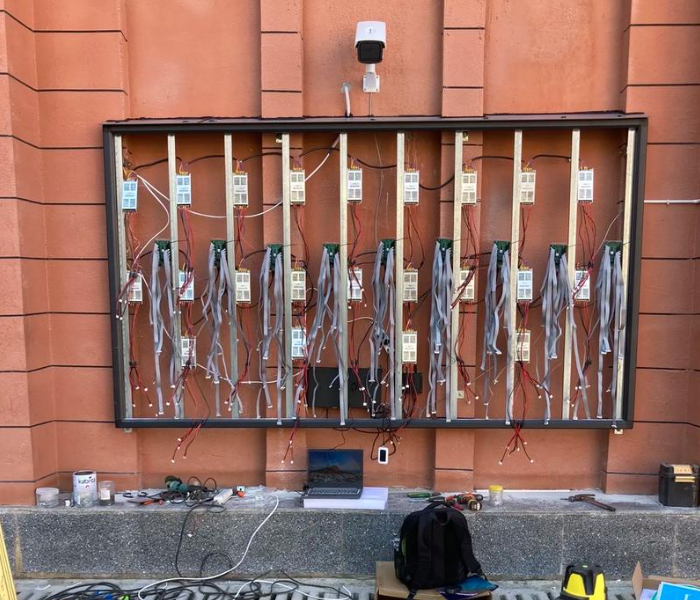
An outdoor LED display covering tens or hundreds of square meters should not be treated as a single unified load. A more practical approach is to divide the supply into zones based on the physical structure of the screen, installation areas, and actual load distribution — with each zone served by its own relatively independent circuit, all managed from a main distribution board.
The value of this goes beyond load distribution.
If one circuit develops a fault, the affected area is contained — the entire screen does not go dark simultaneously. Maintenance teams can also identify the fault zone quickly and respond accordingly.
For stadiums, airports, commercial centers, and DOOH advertising projects, this matters considerably. Many of these screens cannot simply be taken offline for maintenance. The smaller the fault footprint, the lower the operational pressure on the maintenance team.
Zone planning also needs to account for the actual distance between the distribution board and each zone. Zones that are farther away cannot simply be allocated based on average power — cable length, current, and voltage drop all need to be checked.
3. Three-Phase Distribution Requires More Than a Total Capacity Calculation
For large outdoor LED displays, three-phase load balance becomes an important consideration.
If a disproportionate share of the load is concentrated on one phase while the other two carry significantly less, the overall operating condition of the system can be affected. This does not always show up immediately after installation — it is more likely to appear during high-brightness, high-load, or extended-duration operation.
Designing the power distribution system for a large LED display means more than arriving at a single total power figure. The load across display zones needs to be distributed across the three phases based on actual load calculations.
For international projects, distribution equipment, protective devices, earthing, and cable specifications all need to comply with the local electrical standards of the installation country. Requirements for low-voltage distribution, earthing, and safety protection vary by region and cannot simply be copied from another project.
4. Calculate Voltage Drop Before the Cables Are Installed
Voltage drop is a common and frequently underestimated problem in large outdoor LED projects.
When the distribution board is located far from the display, the cable run is long and the resistance of the cable causes the voltage at the far end to fall below the supply voltage. The larger the load and the longer the distance, the more significant this becomes.
The on-site symptoms are not always obvious. Some cabinets may still light up normally, but under high-load conditions, brightness anomalies, power supply protection activation, or equipment restarts may occur.
For large projects, voltage drop calculations should be completed before construction begins, with particular attention to display zones that are farthest from the distribution board. This is why two LED display installations of identical area can require completely different power distribution designs.
5. Design the Distribution System for Peak Load
The actual power consumption of an LED display changes with the content being played. The entire power distribution system cannot be designed around a single average power figure.
This is especially relevant for outdoor advertising screens. When playing high-brightness content with large areas of white, the actual load can be substantially higher than during typical video content. A distribution system without adequate capacity margin is more likely to experience protective device activation or power system overload during extended high-load operation.
This does not mean more capacity is always better. Excessive capacity adds to equipment and construction costs and can indicate a poorly calibrated design. The practical approach is to determine a reasonable capacity based on actual product power consumption, the project’s operating profile, and safety requirements — while leaving appropriate margin for future maintenance or moderate expansion.
6. Protection and Surge Suppression Are Essential for Outdoor Projects
Outdoor LED displays operate continuously in complex environments. Lightning, static discharge, grid voltage fluctuation, and the switching of other large equipment in the vicinity can all affect the display system.
A complete LED display power distribution system should not consist only of a main circuit breaker and a standard distribution enclosure. Overcurrent protection, short-circuit protection, earthing, and surge protection all need to be considered in line with the local electrical codes of the installation site.
For screens installed on rooftops, freestanding billboard structures, or large outdoor steel frameworks, lightning protection and earthing design cannot be treated as afterthoughts to be addressed once the equipment is in place.
One point worth clarifying: product protection rating and project-level electrical protection are not the same thing. A LED cabinet with a high IP rating does not mean the power supply system has adequate lightning protection, earthing, and surge suppression in place.
A Sound Distribution Plan Starts From the Project as a Whole
The display, power supply, control system, steel structure, and on-site electrical distribution are all part of a single integrated system. If power distribution is not addressed until the construction phase — or after the equipment has arrived on site — there is very little room left to adjust circuits, capacity, or maintenance arrangements.
The real questions to answer are not just “will the screen light up?” They are three more practical ones:
- Is the system stable under high-load operating conditions?
- If one circuit develops a fault, is the affected area containable?
- When maintenance is needed several years from now, can technicians identify the problem quickly?
For large outdoor LED display projects, these three questions tell you far more about whether a power distribution design is genuinely sound than any single total power figure.