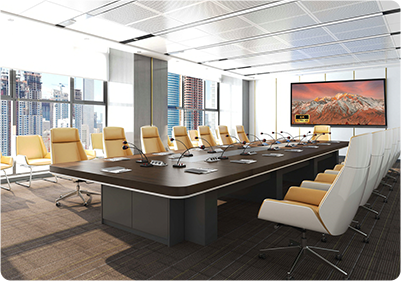


Wall-Mounted Installation: The Most Common and Best-Value Mainstream Solution for Indoor LED Displays
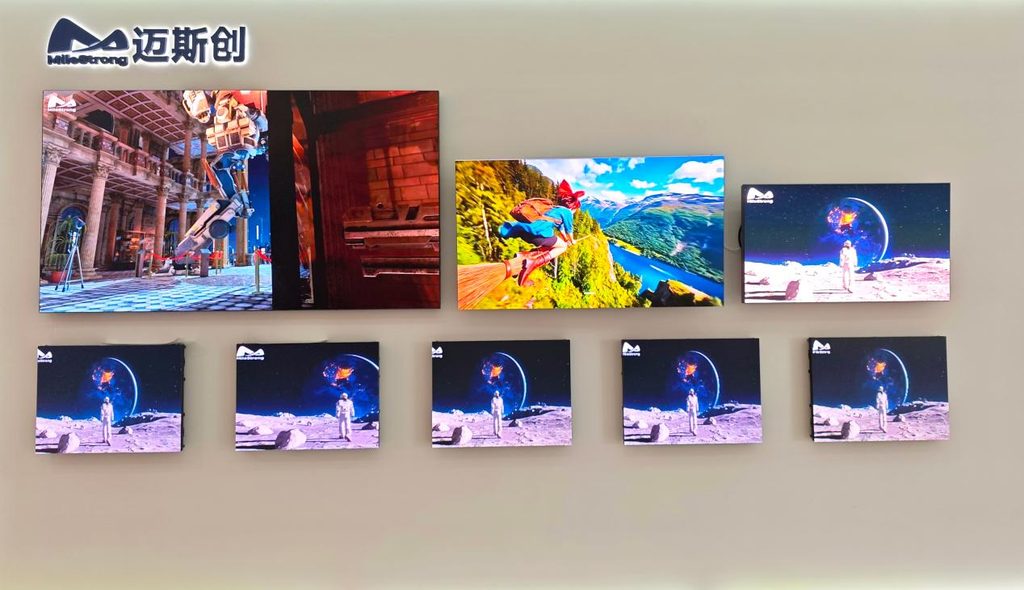
Wall-mounted installation is currently the most widely used method for indoor LED displays. This method primarily involves securing the entire LED display to a solid wall using a custom-made steel frame, corner brackets and expansion bolts.
Key Features
It requires no damage to the building structure, takes up no floor space, has a short installation time-frame and offers excellent overall value for money, making it suitable for the vast majority of standard indoor settings.
Depending on maintenance requirements, it can be categorized into rear-access wall-mounted and front-access wall-mounted types. If there is space reserved behind the screen, opt for rear-access. For fully fitted interiors with no such space, choose magnetic front-access, which does not damage the interior fit-out.
Disadvantages
- Requires the wall to have sufficient load-bearing capacity;
- Plasterboard and hollow partition walls must be reinforced in advance;
- Not suitable for extremely high, open spaces or settings without walls.
Suitable Scenarios
Government and corporate meeting rooms, corporate exhibition halls, reception area feature walls, university lecture theaters, indoor advertising screens in shopping centers, notice screens in lift lobbies, and the vast majority of other standard indoor settings.
Suspended Installation: A Dedicated Solution for Large Spaces With High Ceilings
Suspended installation, also known as overhead mounting, utilizes the building’s load-bearing beams or steel trusses at the ceiling to suspend and secure the entire screen using suspension cables and mounting brackets. The screen is displayed in mid-air without relying on wall support, making it a dedicated solution for high-ceilinged spaces.
Key Features
It occupies absolutely no wall or floor space, offering an unobstructed view and a grand display effect. It is suitable for venues with high ceilings and no suitable walls for installation.
Installation requires rigorous calculation of the ceiling’s load-bearing capacity, the number of suspension points and the load-bearing capacity of the steel framework, whilst strictly adhering to building safety standards.
Disadvantages
- Installation is technically challenging;
- Places extremely high demands on the building’s load-bearing capacity;
- Involves relatively high costs;
- Requires a highly specialized installation team due to the nature of working at height.
Suitable Scenarios
Open spaces with a ceiling height of 5 meters or more, such as sports arenas, large banquet halls, shopping centre atrium, stage lift screens, and large-scale information displays at airports and stations.
Pole-mounted Installation: The Essential Solution for Outdoor Locations Without Walls
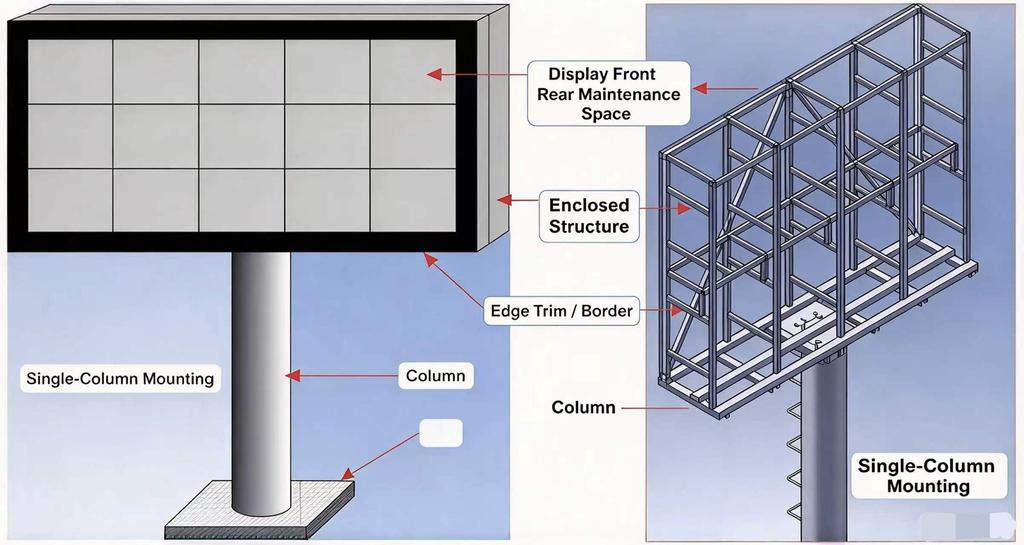
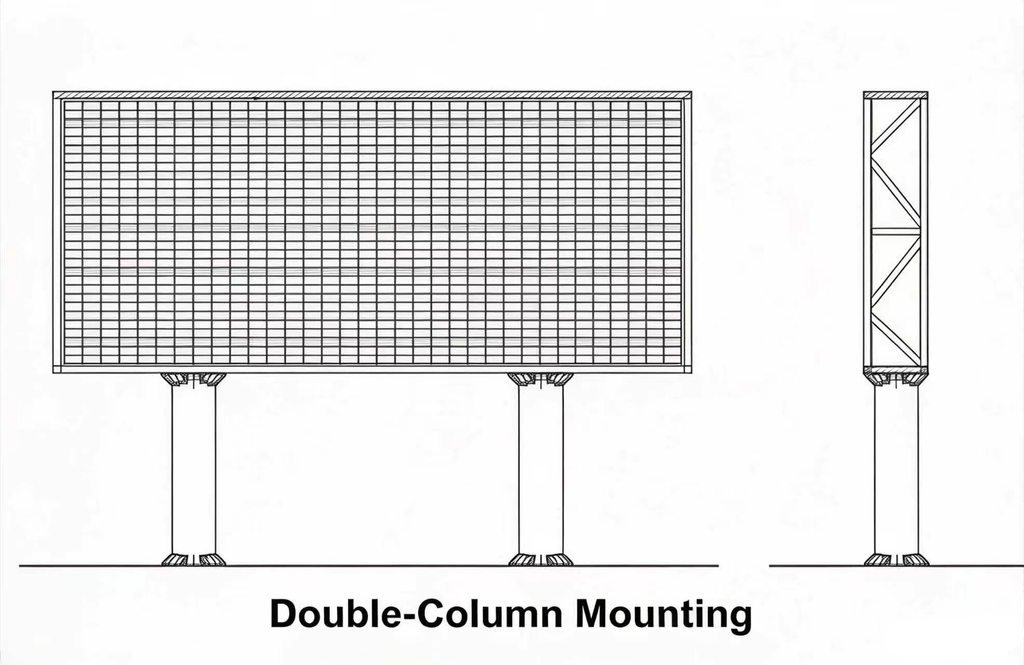
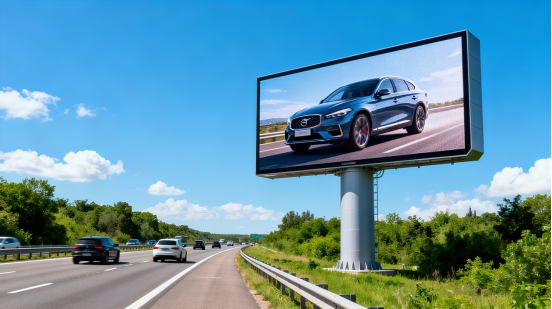
Pole-mounted installation is the mainstream method for outdoor LED displays, divided into single-pole and double-pole configurations. By casting a concrete base and erecting steel poles, the screen is secured atop the poles without the need to rely on building walls.
Key Features
With a self-supporting structure suited to open-air environments without walls, this method offers excellent resistance to wind, rain and sunlight, ensuring high overall stability. It is the preferred choice for freestanding large screens in parks, outdoor squares, school entrances and high streets.
During construction, the base must be designed in accordance with geological conditions and local wind pressure standards to ensure long-term safety.
Disadvantages
- Long construction period;
- High civil engineering costs;
- Requires an open space;
- Necessitates completion of the relevant approval procedures for outdoor LED screens.
Suitable Scenarios
Outdoor advertising screens in parks, notice boards at school entrances, large screens in municipal squares, outdoor screens in shopping streets, promotional screens in tourist attractions, and other outdoor standalone display scenarios.
Recessed Installation: A Minimalist and Aesthetic Solution for High-End, Finished Interiors
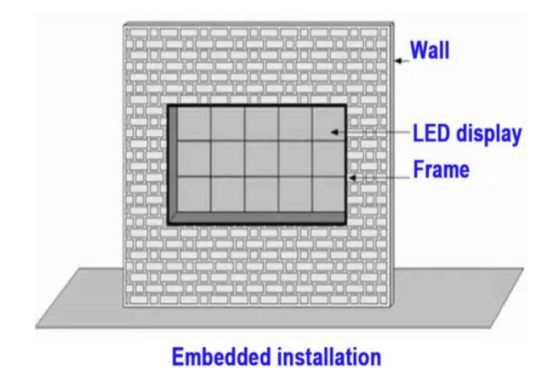
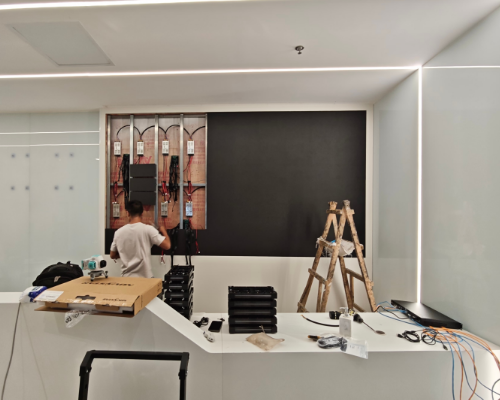
Embedded installation, also known as recessed installation, involves pre-reserving wall openings during the fit-out phase to embed the entire LED screen within the wall, ensuring the screen surface is flush with the wall and free from protruding steel frames or conspicuous structures.
Key Features
The primary advantage is its discreet and aesthetically pleasing appearance, seamlessly integrating with the interior décor. When the screen is off, it blends in with the wall, preserving the overall design aesthetic, making it the mainstream choice for high-end, fully-fitted projects.
It requires precise control over the dimensions of the recessed area, heat dissipation depth and access space for maintenance, placing extremely high demands on measurement and construction accuracy.
Disadvantages
- Must be planned and reserved during the early stages of fit-out;
- Retrofitting is difficult;
- High construction precision is required;
- Special attention must be paid to internal heat dissipation and moisture protection.
Suitable Scenarios
High-end corporate showrooms, luxuriously fitted conference rooms, VIP lounges, museums, exhibition halls, and feature walls in high-end office buildings – in short, scenarios where the aesthetic quality of the fit-out is of the utmost importance.
Quick Selection Comparison for the Four Installation Methods
- Wall-mounted: Standard indoor settings, solid walls, seeking value for money, convenient for subsequent maintenance;
- Suspended: Extra-high ceilings, no suitable wall for mounting, open and spacious areas, seeking a floating visual effect;
- Pole-mounted: Outdoor open-air settings, no structural support, requiring independent display, for visibility from a distance;
- Recessed: High-end, luxuriously finished settings, seeking a minimalist, integrated look, requiring advance planning during the early stages of fit-out.