

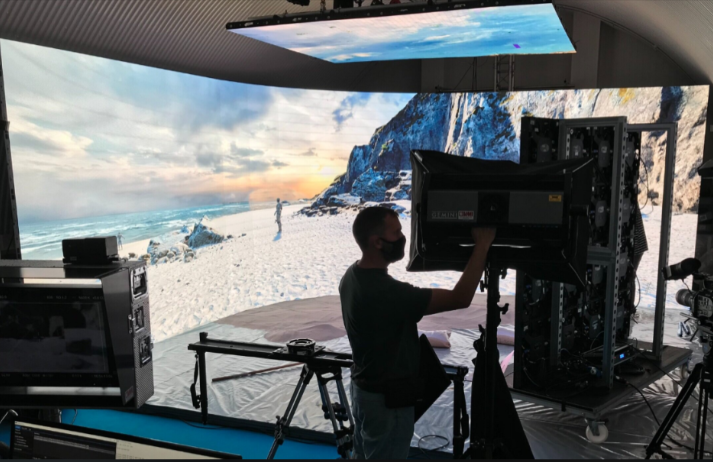
Green screens have been the standard tool for composite visual effects since the 1990s. In fact, they work. But in-camera LED production has moved from experimental to mainstream in the past five years, driven by productions like The Mandalorian and adopted by studios, advertising agencies, and live broadcast operators around the world. This method places actors in front of a large-format LED wall that displays a real-time rendering environment. For buyers evaluating their LED investment, the question isn’t which technology is better. It’s which technology best suits the specific demands of the production you need to support.

Four Dimensions & Objective Assessment
Image Quality
- LED Screen
LED Screens have real lighting interaction. That’s, the LED wall can cast actual light and reflections onto actors and practical props, creating physically accurate integration. They also have no green spill by eliminating the color contamination that affects hair, transparent materials, and reflective surfaces in chroma key work. (Note:Chroma key work refers to green/blue screen background replacement in video post-production.) What the camera captures is what the audience sees and no compositing layer between performance and final image. However, they require high refresh rate (≥3,840Hz) and frame sync to avoid moiré and scan lines. Hardware specification is critical.
- Green Screen
As for green screens, background can be changed or refined in post. But green spill requires correction work in post, particularly on fine hair, glass, and metallic surfaces.What’ s more, lighting on set must be designed to match the background in post. Actors also cannot see and react to the environment naturally.
Production Workflow
- LED Screen
With LED screens, directors and DPs can adjust the virtual environment during the shoot. They can also reduce post-production VFX workload significantly. (Note: VFX refers to digitally created or altered imagery for films, videos and live productions. It includes background replacement, scene creation, image retouching and other post-production visual work.) While they require pre-production investment in 3D environment build and rendering pipeline setup before shoot day. Besides, camera tracking system must be calibrated and integrated with the rendering engine.
- Green Screen
When we use green screens, background can remain undefined at shoot time. And we need simpler on-set technical setup, for example, a well-lit green surface and good key lighting is the primary requirement. But extensive post-production keying, rotoscoping, and integration work is annoying and creative changes to the background after the shoot requires new shoot.
Cost Structure
- LED Screen
Significantly, LED screens can cut the post-production VFX costs because of fewer compositing hours, less rotoscoping, reduced correction work. In addition, they are reusable devices. Moreover, they eliminate location shoot logistics for many exterior scenes. However, they need higher upfront hardware investment, such as LED panels, rigging, rendering engine, camera tracking system.
- Green Screen
Low initial setup cost when we use green screens. For single productions or short-run projects, green screen total cost may remain lower. However, each production starts from zero because green screen infrastructure does not carry the same reuse advantage as a permanent LED volume.
On-Set Experience
- LED Screen
In front of LED wall, actors perform against a visible environment. Director and DP see the final composite in real time on a monitor and no need to imagine what post will deliver. Furthermore, practical lighting from the LED wall responds dynamically to content.
- Green Screen
Actors perform against a uniform green surface. All lighting must be designed and motivated independently of the background being composited later.
Where Each Technology Leads
| Dimension | LED Screen | Green Screen | Verdict |
| In-camera image quality | Leads | Trails | LED Screen |
| Lighting realism & integration | Leads | Trails | LED Screen |
| Post-production workload | Lower | Higher | LED Screen |
| Background flexibility post-shoot | Fixed at shoot | Fully flexible | Green Screen |
| Upfront hardware cost | Higher | Lower | Green Screen |
| Total cost across multiple productions | Improves over time | Resets each time | LED Screen |
| Actor performance & eye lines | Natural | Requires direction | LED Screen |
| On-set setup simplicity | More complex | Simpler | Green Screen |
Not all LED panels perform equally in in-camera production. The specifications that matter for compositing-free capture, such as refresh rate, frame rate, color gamut, and shutter synchronization, have specific requirements that general-purpose LED displays don’t always meet.
The MileStrong LR Series is built specifically for XR production environments. Currently, the LR Series is widely applied in XR studios, film and TV production, live concerts, immersive experience centers, live streaming, corporate events, exhibitions, and other commercial spaces. Request a consultation — MileStrong provides end-to-end support from spatial planning to on-site commissioning.