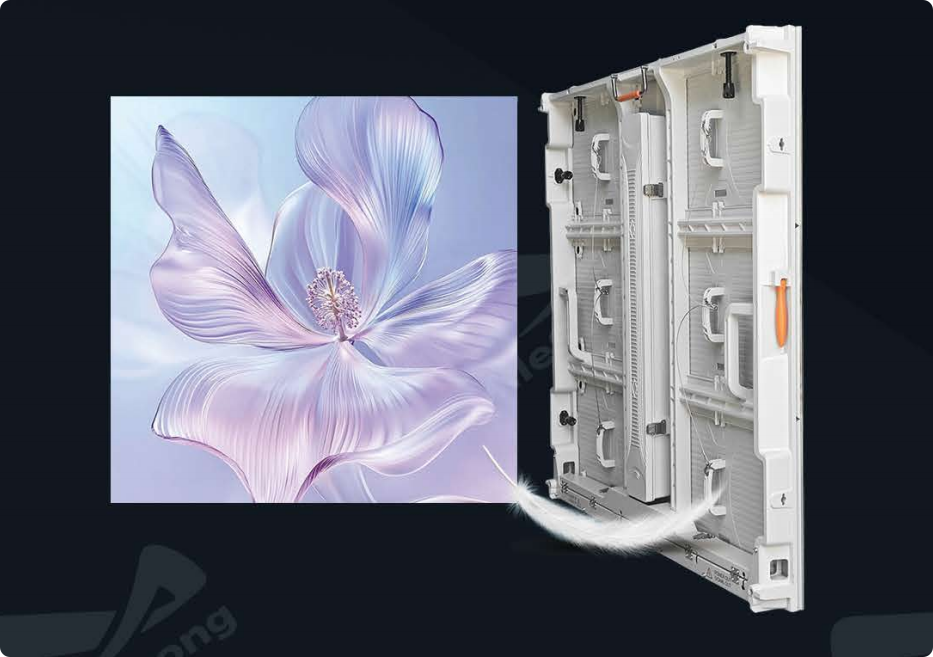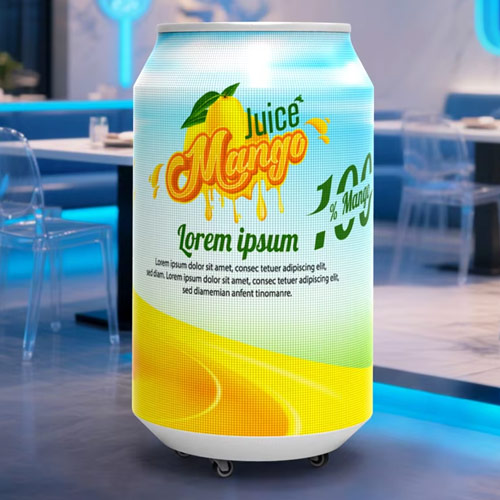


From outdoor billboards and stadium screens to conference rooms, control centers, and commercial spaces, LED displays have become an important part of modern digital displays. Looking back at the history of LED display technology, a clear evolutionary path can be seen: from DIP to SMD, then to IMD, COB, and now the continuously developing Mini LED and Micro LED.
DIP LED Technology:: The Durable Choice for Outdoor LED Displays
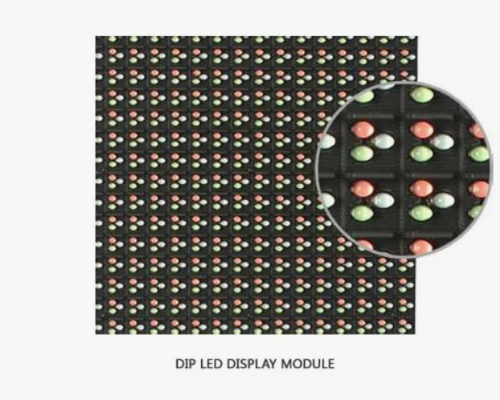
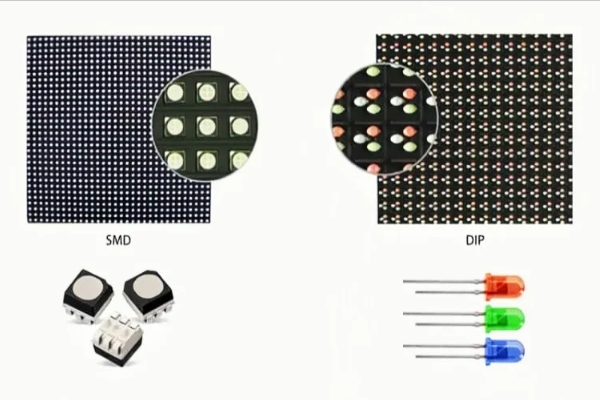
DIP (Direct In-Package) was a widely adopted technology for early LED displays. LED chips are directly mounted to the PCB board via pins, offering a mature structure, high brightness, and good adaptability to outdoor environments. Therefore, it has long been used in outdoor advertising, stadiums, and traffic displays.
However, DIP chips are relatively large, limiting pixel density improvements and resulting in noticeable graininess when viewed at close range. As market demand for high-definition LED displays increases, DIP is gradually giving way to the more integrated SMD (Surface Mount Device) technology.
SMD LED Technology: Driving LED Displays Toward High Definition
SMD (Surface Mount Device) uses a surface mounting method to directly mount LED devices onto the PCB. Compared to DIP (Dual In-line Package), SMD offers advantages such as smaller device size, higher pixel density, higher degree of production automation, and wider viewing angle.
The widespread adoption of SMD has driven the rapid development of LED displays from traditional outdoor displays to indoor high-definition displays and small-pitch LED displays, and for a considerable period, it has been the mainstream packaging solution in the LED display market.
IMD and COB LED Technology for Fine-Pitch Displays
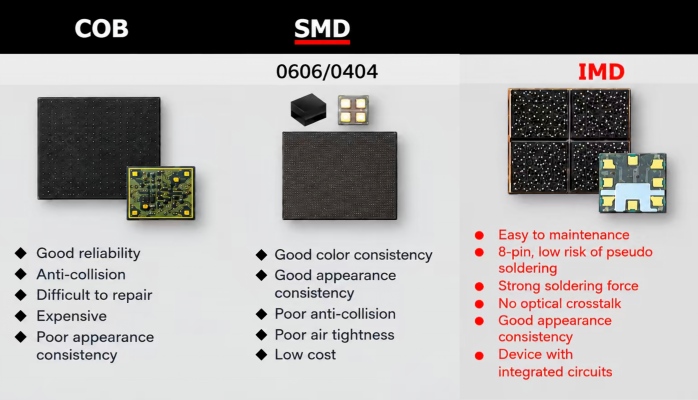
As LED displays enter the era of smaller pitch (below P1.0), traditional single-chip SMD faces challenges in terms of device size, mounting accuracy, and reliability.
IMD (Integrated Matrix Device) improves device integration by integrating multiple RGB pixels into a single package, becoming an important technology in P0.x small-pitch LED displays.
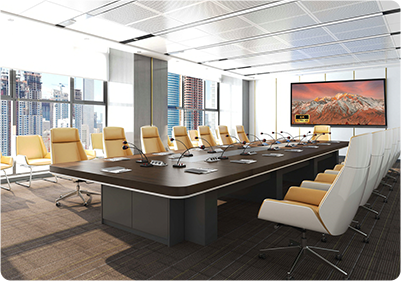
COB (Chip on Board) further integrates bare LED chips directly onto the display substrate and enhances surface protection through overall packaging. Due to its high integration, excellent close-range display performance, and strong surface protection, COB is particularly suitable for applications such as high-end conference rooms, control centers, studios, and ultra-high-definition LED displays.
Mini LED and Micro LED: Next-Generation Display Technologies
Mini LED Display Technology
Mini LED chips are typically in the tens to hundreds of micrometers range, with 75–300 μm often used as an industry reference range. In many implementations, the LED chips are grown on sapphire substrates before being processed and assembled into display systems. For LCD applications, Mini LED is primarily used as a high-density backlight source. Combined with local dimming, the technology can improve brightness control, contrast ratio and HDR performance compared with conventional LED backlights.
Mini LED can also be used directly in fine-pitch LED displays and video walls. Mini LED technology gained significant commercial attention around 2019–2020, with manufacturers expanding production capacity and application scenarios during this period.
Micro LED Display Technology
Micro LED uses microscopic LED chips, commonly defined as being below 100 μm, with some industry definitions using 75 μm or below. Unlike Mini LED backlights, Micro LED displays are self-emissive: individual RGB LED chips function as pixels and emit light directly. During display manufacturing, Micro LED chips are transferred from their growth substrates onto a display backplane or other receiving substrate using mass-transfer technologies. This enables highly dense pixel arrays and supports applications requiring high brightness, high contrast, fast response and long operating life.
Micro LED also offers potential advantages in ultra-thin, flexible and unconventional display designs, depending on the device architecture and substrate. The technology is being developed for applications including large-format displays, TVs, automotive displays, wearables and AR/VR devices, although manufacturing yield, mass transfer, repair and cost remain important challenges for large-scale commercialization.
Conclusion
From DIP and SMD to IMD and COB, and then to Mini LED and Micro LED, LED display technology has consistently evolved around achieving higher resolution, higher reliability, higher brightness, and a superior visual experience.
It’s important to note that DIP, SMD, IMD, and COB primarily belong to LED packaging and integration technologies, while Mini LED and Micro LED represent more about chip size and display form factor. Therefore, the future will not see any one technology completely replacing others; rather, different LED display technologies will continue to coexist and develop according to application needs.