

LED floor tile screens are LED display devices installed on the ground. They can not only play videos, images, and dynamic content, but also change in real time based on people walking, stepping, and other actions. So, how do LED floor tile screens achieve interactivity? This article will explore the secrets of interactive LED floor tile screens.
What Is an Interactive LED Floor Tile ?
Ordinary LED floor tile screens primarily handle “display.” Interactive LED floor tile screens add another function: sensing human actions and providing visual feedback.
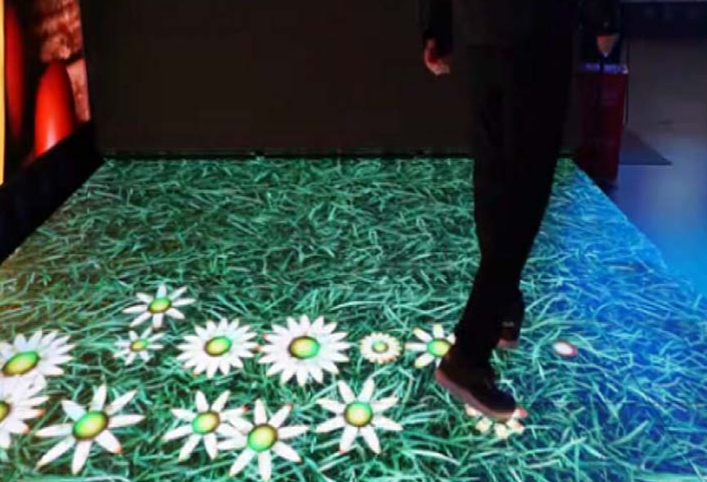
For example, when a person walks across the screen, ripples may appear under their feet; flowers on the screen may bloom after stepping on a certain area; and the image may change according to the positions of multiple people entering simultaneously.
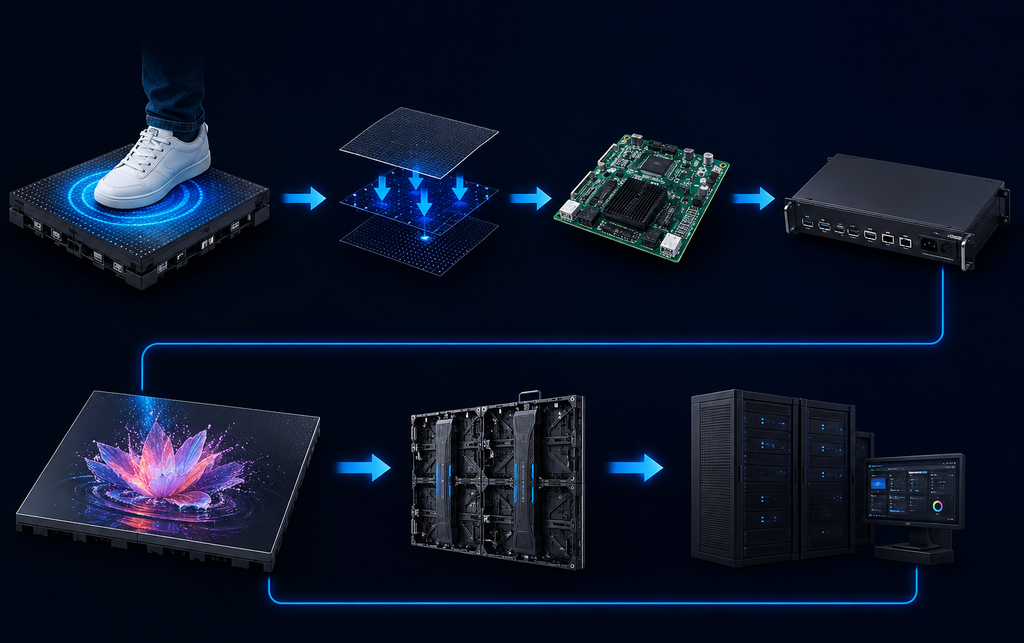
Therefore, it can be understood as: Human action → System detection → Software analysis → Screen feedback. This is the basic process of interactive LED floor tile screens.
How Is LED Floor Tile Screen Interaction Achieved?
1. The LED Floor Tile Screen Is Responsible for Displaying the Image
LED floor tile screens consist of a large number of LED beads and can display videos, images, animations, and other content. Compared to ordinary indoor LED displays, floor tile screens need to withstand people walking on them. Therefore, they usually use a more robust cabinet and mask structure. At the same time, LED floor tile screens can be customized with different pixel pitches, sizes, and installation methods according to project requirements.
The floor tile screen is responsible for the final step in this interactive process: displaying the interactive result.
2. Sensors Are Responsible for Detecting People
The LED screen itself alone cannot accurately determine the location of people. Therefore, interactive systems usually require the addition of sensors.
Common methods include infrared sensors, pressure sensors, cameras, and radar. Different devices use different detection methods.
For example, pressure sensors can detect the pressure on the ground; cameras can identify the location and movement of people; radar can detect the distance and direction of movement of people.
Sensors are like the “eyes” of a person. They are responsible for collecting on-site information during the interactive process.
3. Interactive Software Is Responsible for Understanding Actions
After the sensors detect information, it needs to be processed by the interactive software.
For example, if the system detects a person stepping on area A, the software can determine:”Someone has entered this location”. Then, according to pre-set rules, it will display water ripples, light circles, or other animations in area A. If the user moves to the right, the screen will also move accordingly.
Therefore, the interactive software is the “brain” of the entire system.
4. The Control System Is Responsible for Making the Screen Change
After the software completes its judgment, it needs to transmit instructions to the LED control system. The control system then sends the corresponding content to the LED floor tile screen. Thus, the user will see real-time changes.
The whole process is very fast. Under normal circumstances, users will not notice a significant waiting time, resulting in a more natural interactive experience.
Summary
The interactivity of LED floor tiles is not achieved solely by the screen itself.It is the result of the collaborative work of the LED display, sensors, interactive software, and control system.
When a person moves, the sensors detect it, the software interprets it, and the LED floor tile screen provides the feedback.This system transforms the ground from an ordinary space into a “perceptible” digital interactive area.
For commercial spaces, exhibition halls, museums, and entertainment projects seeking to create immersive experiences, interactive LED floor tile screens offer a more intuitive and engaging visual experience, while also allowing for more flexible spatial displays.