

For the fine-pitch LED display, COB technology has been a consistent focus of industry discussion, particularly since products below P1.0 began to appear and traditional SMD packaging technology started to show its limits. As LED chips get smaller and packing density increases, making the technology work reliably in practice has become a central concern for manufacturers and project teams alike.
COB emerged as a response to this challenge. But COB is not a single technology. Two main approaches are common in the market today:
- Wire-Bond COB
- Flip-Chip COB
The internal structures are meaningfully different. For buyers, understanding the distinction helps determine which approach is the better fit for a specific project.
What Is a COB LED Display?
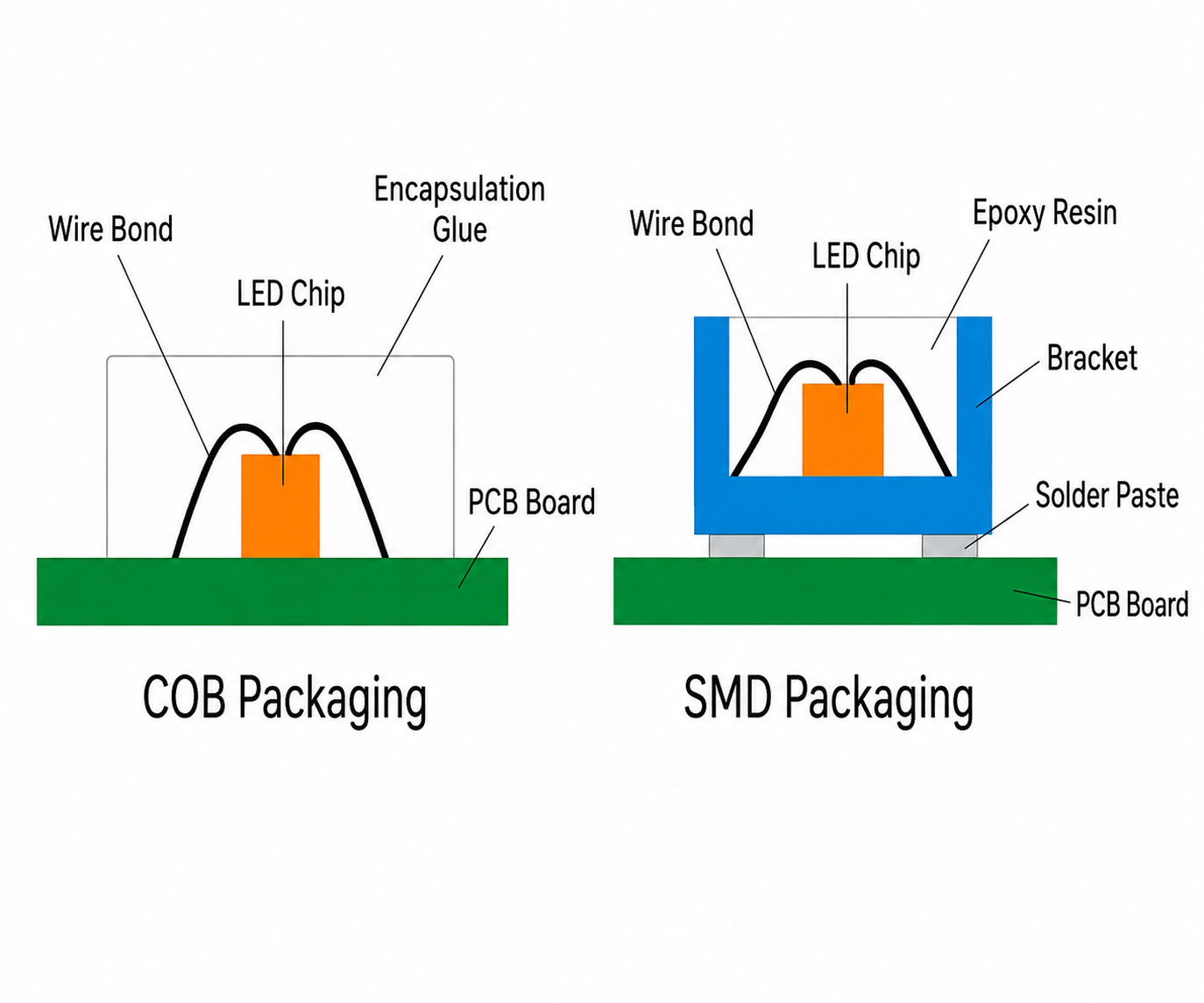
COB stands for Chip On Board. In simple terms, LED chips are mounted directly onto a PCB and protected by an encapsulation material — bypassing the individual chip packaging step required by traditional SMD. The result is a more compact structure, which is one of the main reasons COB suits fine-pitch LED display applications.
Standard SMD LED requires each chip to be packaged individually before being mounted on the PCB surface. COB integrates the chip directly onto the circuit board, reducing the distance between light-emitting units. For products at P0.9, P0.7, and smaller, this structural approach has clear advantages.
But the question of how the chip connects to the board leads to the two different technology paths.
Wire-Bond COB: The Established Approach, With Some Limitations
Wire-Bond COB, also called traditional COB packaging technology, mounts the LED chip face-up on the PCB and uses gold wire or similar bonding to make the electrical connection between the chip electrode and the PCB circuit.
This approach has been developed over a longer period and carries higher process maturity. Cost control is relatively straightforward.
For many indoor fine-pitch LED projects, Wire-Bond COB meets the requirements comfortably. Meeting rooms, showrooms, and educational spaces using P1.2 or P1.5 displays can be well served by this approach.
However, as pixel pitch continues to shrink, limitations start to appear. The gold wire bonding structure requires space and affects how densely chips can be arranged. As products push toward smaller pitches, the room for structural optimization narrows. At very small scales, every fraction of a millimeter matters.
Flip-Chip COB: Developed for Finer Pixel Pitches
Flip-Chip COB takes a different approach. The key difference is the chip orientation. In flip-chip packaging, the LED chip electrode faces downward and connects directly to the PCB through soldering — without the gold wire.
A simple way to visualize the difference:
- Wire-Bond COB is like a chip standing up and connecting via wire;
- Flip-Chip COB is like a chip flipped over and bonded directly to the surface.
This structure eliminates the gold wire requirement and shortens the electrical connection path.
- Chip layout can be more compact. For ultra-fine pitch displays — P0.9, P0.7, and below — Flip-Chip COB makes high-density arrangement more achievable.
- There is also a thermal advantage. Heat generated by the chip travels through a shorter path to the PCB, which supports better long-term operational stability.
Core Differences Between Wire-Bond COB and Flip-Chip COB
From a project selection perspective, the differences come down to a few key areas.
- Chip connection method.
- Wire-Bond COB uses gold wire bonding.
- Flip-Chip COB uses direct soldering with the chip inverted.
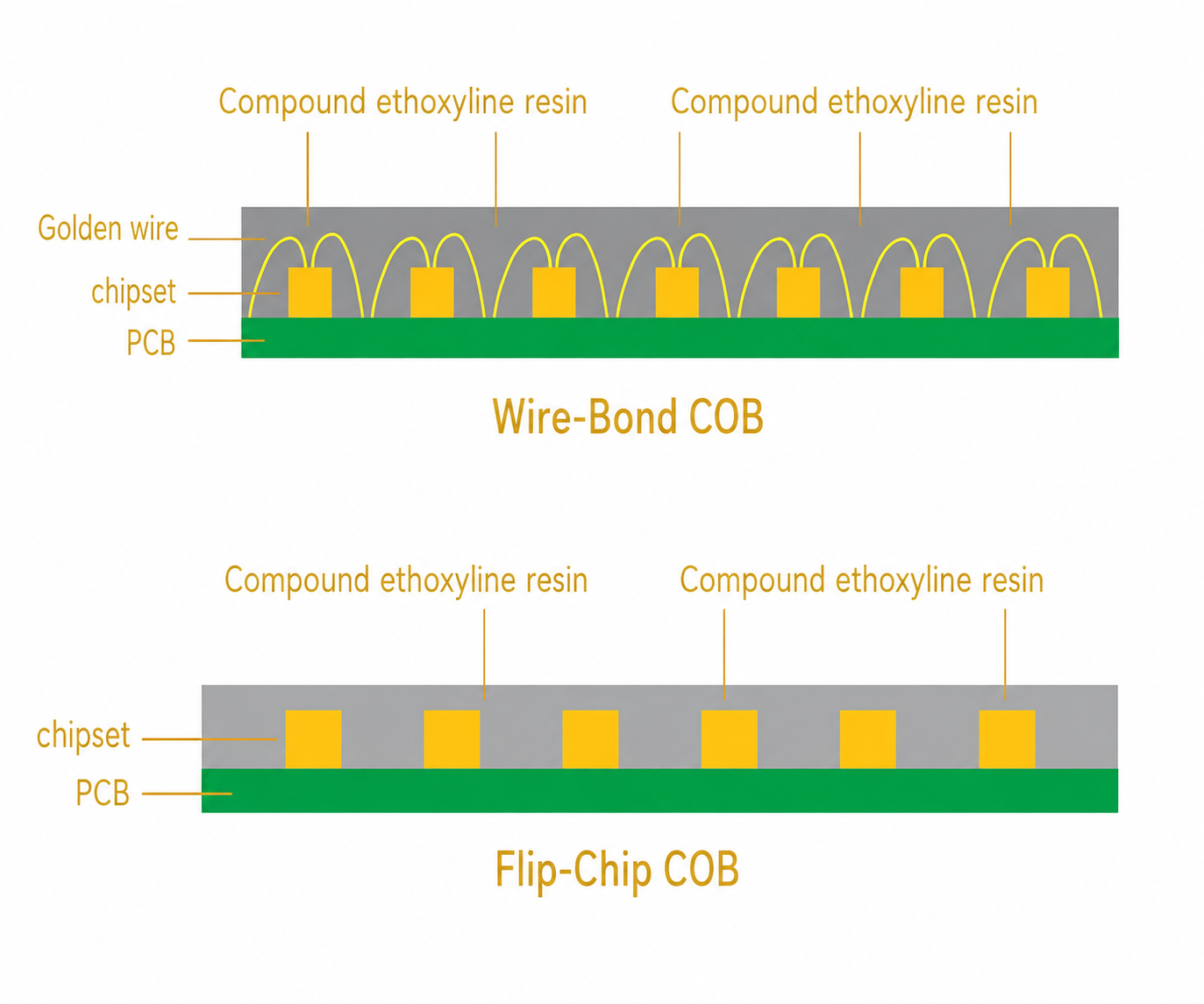
This structural difference drives the performance distinctions that follow.
- Fine-pitch capability
Both can be applied to standard fine-pitch LED displays. But as pixel pitch shrinks further, Flip-Chip COB generally has the advantage. It reduces packaging space constraints. Below P0.9, more manufacturers are moving toward Flip-Chip COB configurations.
- Thermal performance
LED displays run for long periods, making heat management important.
- Wire-Bond COB has a relatively longer thermal path due to the gold wire structure.
- Flip-Chip COB’s direct chip-to-PCB connection creates a shorter theoretical heat dissipation path.
That said, the final result depends on PCB design, encapsulation materials, and the overall thermal management approach — packaging form alone is not the whole picture.
- Manufacturing cost.
- Wire-Bond COB has a more mature process and a more established supply chain, which keeps cost pressure lower.
- Flip-Chip COB requires higher-precision manufacturing equipment and places greater demands on chip and soldering quality. Pricing is typically higher.
How to Choose Between Wire-Bond COB and Flip-Chip COB
There is no universally better technology — only a better match for the application.
- For standard meeting room displays, commercial showrooms, educational display spaces, and fine-pitch projects at P1.2 and above, Wire-Bond COB meets the requirements in most cases.
- For ultra-high-definition command centers, broadcast studios, XR virtual production, and products moving toward sub-P0.9 Micro LED territory, Flip-Chip COB is more aligned with where the technology is heading.
In XR virtual production, for example, the LED background is captured at close range by cameras. Any minor defect affects the final image. These projects prioritize pixel density, reliability, and stable long-term operation, which is why they tend to favor more advanced packaging solutions.
Where Is COB Technology Heading?
COB is not a simple replacement for SMD. It is better understood as an important pathway for LED displays to move toward finer pixel pitches. But different projects have different needs.
- Some require cost control.
- Some prioritize image performance.
- Some focus on maintenance cycles.
Wire-Bond COB and Flip-Chip COB will continue to coexist rather than one displacing the other. For LED display buyers, what matters is not the technology name — it is whether the product is matched to the operating environment. The display ultimately serves a specific use case. Packaging technology is one of the key factors that determines whether it does that reliably.