

An LED display usually means a wall, an advertising space, or a window for playing content. Hangzhou’s Xizi Corridor Bridge changed that assumption.
The LED display system here does not just show dynamic imagery. It works in coordination with mechanical structures, live performance, and the architecture around it — giving an ordinary pedestrian corridor the ability to “open up” and “perform.” From building facade to city theater, the Xizi Corridor Bridge shows LED display technology entering a new phase. It is no longer just presenting information. It is reshaping how people interact with urban space.
Project Location
The Xizi Corridor Bridge sits in the commercial heart of Hangzhou’s Hubin Pedestrian Street, connecting different sections of the lakeside commercial district and facing directly onto West Lake. It is one of the highest-footfall public spaces in the city. That location means it carries more than an advertising function — it is part of the city’s public experience.
What the Project Actually Uses
Large-Format LED Display System
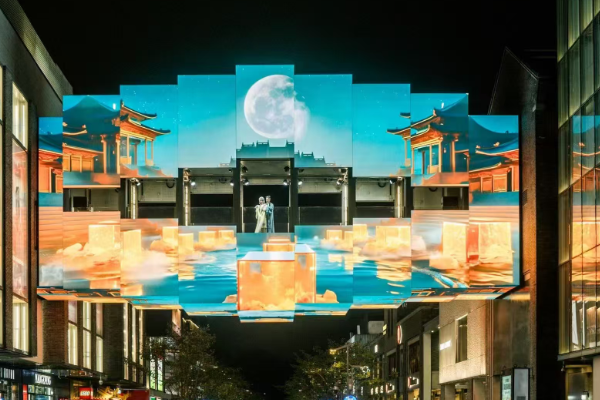
Almost the entire exterior of the bridge structure is covered by LED. From a distance, it reads as a complete Digital Facade. The display can carry naked-eye 3D content, city cultural content, seasonal animations, brand campaigns, and performance visuals.
Mechanically Operated Opening Structure
This is the defining feature of the entire project. The screen is not fixed in place.
Before a performance begins, the LED facade slowly opens. A hidden stage inside gradually becomes visible. Performers appear from behind the screen. The LED imagery and the live performers merge seamlessly. The effect is similar to a theater curtain rising — except the curtain is a full digital facade.
Many people seeing it for the first time do not realize there is a complete performance space hidden behind the screen. This is why so much short-form video content captures the moment the screen opens. The visual contrast it creates is striking — and that contrast is what makes it shareable.
Stage Lighting System
The LED display is no longer a standalone device. It has become one component within a complete stage system — alongside stage lighting, sound, the control system, and multimedia synchronization.
Why Did This Project Get So Much Attention?
Many people assume it is because the screen is large. That is not actually why.
Large LED screens are common across China. What is genuinely different here is that the relationship between people and the LED screen has changed. The relationship between the building and the LED screen has changed. The relationship between the city and the LED screen has changed.
How the LED Industry Would Classify This
From an engineering perspective, the real complexity of the Xizi Corridor Bridge is not the LED display itself. It is the coordination between multiple systems running together.
The LED display system handles the digital imagery. The stage mechanical system executes the opening and closing movement. The lighting system shifts the atmosphere in response to the performance. The sound system creates the on-site immersive experience. The multimedia control platform coordinates timing and synchronization across all of these systems simultaneously.
What the audience experiences as a single seamless performance is actually built on the tight integration of display, mechanics, lighting, sound, and digital content working in concert. This is why the Xizi Corridor Bridge is better understood as a digital media integration project rather than any single category of LED display installation. What it demonstrates is the combination of system integration capability, architectural integration capability, and digital content operations — and it represents the direction the LED display industry is moving, from hardware manufacturing toward comprehensive spatial solutions.
The Industry Trend Behind the Project
Globally, the development of architectural media facades, immersive digital spaces, and urban digital art installations is accelerating. These projects vary in form, but the core logic is consistent: buildings that can express something, spaces that can respond, and digital content that becomes part of the urban experience.
For the LED industry, this means future project requirements will be more comprehensive. Beyond the hardware itself, projects will require consideration of architectural integration methods, maintenance structure design, control system compatibility, multimedia coordination, and long-term content operations. Hardware performance remains the foundation — but what ultimately determines project value is system integration capability and spatial innovation capability.
That is the significance of the Xizi Corridor Bridge. It did not redefine LED display technology. It showed another possibility for what LED display technology can do within urban public space. When a display screen works together with architecture, staging, performance, and digital content to build a complete experience, the value it creates has moved beyond what we traditionally think of as information display.