

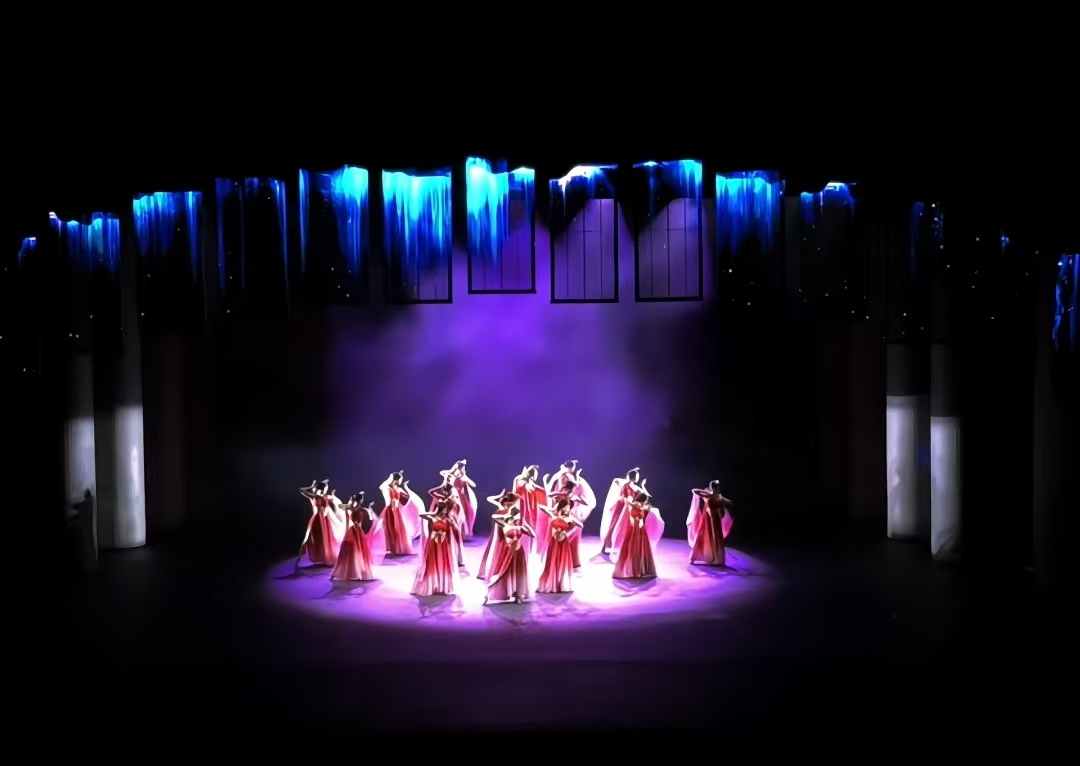
As the music and lighting shift, LED screens descend slowly from above the stage. Digital figures, ink-wash light and shadow, and live performers share the same space. Light passes through the transparent LED screens and continues deep into the stage. Performers move between them. Image and reality weave together, giving the entire stage a richer sense of depth and dimension.
A recent stage production combining traditional drama with digital scenic design has attracted considerable attention. Unlike the large LED backdrops most audiences are familiar with, this production did not cover the entire rear of the stage with a single screen. Instead, it used a set of vertically arranged transparent LED panels that could be raised and lowered during the performance.
Most audience members focused on what appeared on screen — treating it as a visual technology upgrade. But for scenic designers and theater engineering teams, what made this production worth paying attention to was not what the screens displayed. It was the fact that the way the stage space expressed itself had changed.
- In the past, large LED displays served primarily as backgrounds — switching scenes, building atmosphere, carrying most of the visual content.
- In this production, the transparent LED panels were no longer just a backdrop. They were participating in the performance.
This change was not driven by a desire to use newer display technology. It came from a shift in how the stage production was conceived.
- Traditional opera, dance drama, and cultural tourism performances increasingly emphasize the relationship between performers and space.
- Directors want performers to move through the scene — not stand in front of a large screen.
- Lighting designers want to preserve the way beams travel through space, continuing to shape the stage’s atmosphere rather than being blocked entirely by a solid backdrop.
The Stage Is No Longer Built Around a Single LED Screen
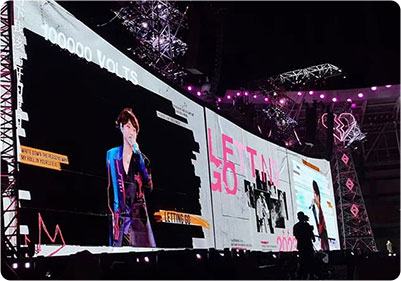
For concerts, sports events, and brand launches, a full LED Video Wall remains a highly effective solution — these formats prioritize a complete image and strong visual impact. But theatrical production follows a different creative logic. It needs space. It needs breathing room. Performers need freedom of movement.
When the entire stage is occupied by a large background screen, the spatial relationship becomes one-dimensional. A visible separation forms between the performer and the image behind them.
Movable vertical transparent LED displays offer a different possibility. They can carry digital content without completely blocking the space behind them. The gaps between panels allow performers to pass through freely. Lighting, haze, and physical scenic elements can continue to contribute to the stage composition.
More Than a LED Display: When Transparent LED Becomes Part of the Stage
Look carefully at productions like this and a detail becomes apparent that is easy to miss: the transparent LED panels do not stay fixed. They descend slowly as the scene develops. They rise again when scenes change. At one moment they form a digital screen divider. At another they become a scroll suspended in mid-air. For the audience, this reads as a smooth visual transition. Behind the scenes, every movement involves the stage mechanics, lighting, video system, and show control system running in coordination.
Productions like this value specifications such as brightness, refresh rate, and resolution. But whether the systems work together seamlessly matters just as much. When a director calls a cue, the fly system begins to move, the transparent LED panels descend in sync, the lighting adjusts its angle, the digital content plays to the timeline, and the performers reach their marks at the same moment. A delay in any one of these elements breaks the audience’s immersion in the story.
In theater, the LED display system is no longer a standalone piece of equipment. It is part of the overall stage control system. The role the transparent LED display plays here is completely different from a traditional backdrop screen. It needs to deliver high-quality image output without interfering with lighting design or performer movement. It also needs to meet the practical demands of rigging, repeated raising and lowering, and accessible maintenance.
This is why more stage projects now plan the display system, stage mechanics, and lighting system together from the outset — rather than designing each separately and connecting them at the end.
Different Stages, Different Design Priorities
There is no single transparent LED solution that fits every theater environment. Building structure, stage dimensions, and production content all influence which product is the right choice.
- Some theaters prioritize image detail and long-term stable operation — once the display system is installed, its position rarely changes.
- Some stages need to reconfigure their layout frequently between shows, requiring display equipment that can be rigged, removed, and reassembled quickly.
- Some cultural centers serve both performance and everyday exhibition functions, and need one system that can adapt to both.
MileStrong applies this thinking to its transparent LED display range.
- The STB Series Transparent LED Display is better suited to fixed-installation theaters and arts spaces — maintaining visual transparency while delivering fine image quality.
- The STH Series and STJ Series are designed for stage environments that require flexible rigging and fast deployment, making it easier to integrate with different stage mechanics for raising, lowering, and reconfiguring the display layout.
Looking Beyond the LED Screen
What transparent LED display brings to the stage is not more imagery. It is more expressive space. It can be a scroll that unfolds gradually. It can be a surface that connects the physical world to a digital one. It can change the atmosphere of the stage as the story develops. For theater design, that kind of change is far more valuable than simply increasing resolution.
This type of stage design no longer pursues larger LED backdrops, but focuses more on the synergy between different technologies. Transparent LED displays, stage machinery, lighting control, and digital content work together to create a freely adaptable stage space. Technology no longer steals the audience’s attention, but quietly serves the performance itself; this may be the truly noteworthy direction for the development of modern stage design.