
In modern LED display engineering systems, LED modules are the smallest imaging units that make up the entire screen, and they are also the core components that determine the screen’s image quality, stability, protection capabilities, and service life. During the project design phase, the vast majority of users and engineering firms focus primarily on LED pitch, brightness, refresh rate, and grayscale parameters, yet they often overlook the module connection method. In fact, the connection process forms the underlying framework of an LED screen, directly determining the screen’s assembly precision, structural stability, vibration resistance, environmental adaptability, and life-cycle maintenance costs.
In actual project implementation, a large number of common failures are directly related to the improper selection of connection methods. Examples include inconsistent seam widths, localized color shifts in the image, screen flickering or blackouts, signal disconnections, short circuits caused by water ingress or dust accumulation in outdoor installations, poor contact resulting from prolonged vibration, and excessively high damage rates during installation and disassembly. To reduce failure rates at the source, enhance display performance, and control post-sales costs, it is essential to first understand the characteristics of module connection processes.
Currently, the module connection methods commonly used in the global LED display industry fall into two main categories: soft connections and hard connections. Neither method is inherently superior; they simply differ in design logic, suitable scenarios, cost structures, and O&M systems. Soft connections emphasize flexible adaptation, high fault tolerance, cost-effectiveness, and the ability to create irregular shapes; hard connections emphasize high precision, high stability, high protection, and low O&M burden.
To help industry users make precise selections, avoid engineering pitfalls, and align project budgets with application requirements, this article will provide an in-depth analysis covering technical definitions, structural principles, process details, advantages and disadvantages, application suitability, and common FAQs. It will address various LED application scenarios—including commercial displays, engineering displays, rental and event displays, and creative custom shapes—to provide standardized selection criteria for different types of LED display projects.
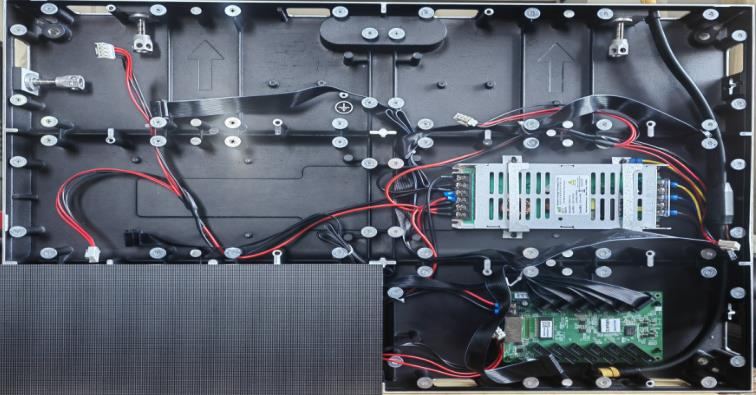
The soft connection method for LED modules is a traditional assembly technique characterized by the longest history of development, the most mature technology, and the widest range of applications. Its core design logic relies on structural flexibility and externalized wiring for connections. Signal transmission and power supply for the module assembly do not depend on direct circuit board-to-board mating; instead, interconnections—between the module and the receiving card, the power supply, or other modules—are achieved via independent flexible ribbon cables, power cords, and signal cables.
Soft-connection modules primarily utilize Flexible Printed Circuits (FPC) as their base substrate, offering excellent resistance to bending, twisting, and deformation. Combined with external, movable cabling, the overall structure allows for significant installation tolerance. Even in the presence of minor manufacturing errors in the cabinet or slight flatness deviations in the mounting surface, the flexibility of the cables allows for fine-tuned adjustments to ensure successful assembly, avoiding issues such as installation failure, deformation caused by forced fitting, or seam separation.
Visually, soft-connection modules are easily identified: upon unboxing, ribbon cables and connectors extending from the rear are clearly visible, and the cabinet interior contains numerous pluggable cables. With its intuitive structure and ease of assembly and disassembly, this method is the mainstream choice for irregular-shaped screens, rental displays, and standard outdoor screens.
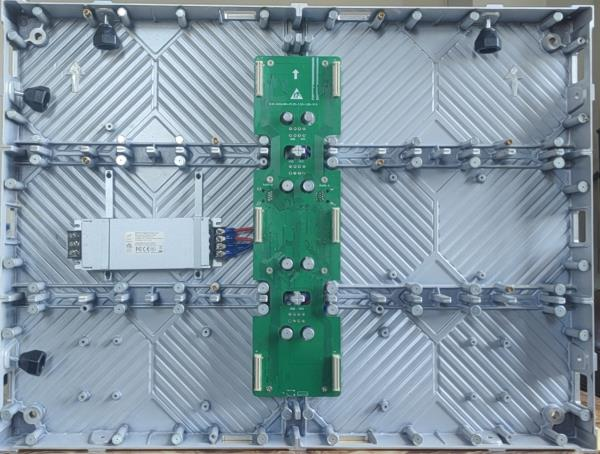
Hard-connection technology for LED modules represents a new generation of integrated, precision connection processes that have emerged alongside the evolution of fine-pitch, high-definition LED display technology. Its core design philosophy centers on on-board circuit integration, the elimination of external cabling, and precise mating via rigid contact points. This process completely abandons traditional connection methods—such as external ribbon cables and plug-in terminals—by fully integrating power supply lines, signal transmission lines, and circuit traces within the rigid PCB itself.
Hard-connection modules eliminate all exposed wiring, relying instead on precision on-board metal contacts, board-to-board connectors, magnetic positioning structures, and mechanical locking mechanisms to achieve precise mating between the module and the cabinet, as well as between the module and the control system. The module features a rigid, non-flexible structure that cannot be bent or twisted; alignment at connection points relies entirely on mechanical positioning, thereby eliminating visual defects caused by human error during installation.
Characterized by high precision, high integration, and high stability, hard-connection technology has become the standard for indoor fine-pitch LED screens, high-end commercial displays, large-scale command center screens, and fixed high-end engineering displays; it also represents the mainstream development trajectory for future high-end LED display equipment.
The flexible substrate and movable wiring of these modules allow for multi-angle bending, wrapping around curved surfaces, circular splicing, and the creation of irregular shapes. Whether for large curved screens in shopping mall atrium, cylindrical LED wraps for pillars, circular stage canopies, curved displays at auto shows, uniquely shaped light-and-shadow screens in bars, or creative irregular displays in art galleries, flexible modules adapt perfectly. They represent the only technical solution in the industry capable of realizing complex, non-standard LED display shapes.
Flexible modules feature a lightweight structure and simple disassembly; individual modules can be removed independently without dismantling the entire screen. In rental scenarios—such as stage performances, commercial events, trade shows, and weddings—equipment undergoes frequent assembly, disassembly, packing, and long-distance transport. Flexible modules can be stacked for storage, withstand slight deformation (providing a cushioning effect), and suffer low damage rates. This significantly reduces the burden on storage, lowers transportation costs, and minimizes losses during equipment turnover.
Flexible modules utilize an independent wiring design. If a single module experiences a black screen, dead pixels, or flickering, technicians simply disconnect the specific module’s wiring terminal and replace that unit alone—eliminating the need to dismantle large sections of the screen or recalibrate system-wide parameters. Repairs can be performed by standard technical staff; the process is rapid and causes minimal disruption to ongoing business operations or events.
The manufacturing process for flexible modules is mature, utilizing low-cost raw materials and offering high production efficiency, while requiring minimal supporting cabinetry or specialized installation equipment. For standard projects with limited budgets and moderate precision requirements—such as large outdoor advertising screens, campus information displays, standard retail screens, or long-distance landscape displays—these modules minimize project costs while fully meeting display needs, making them suitable for the vast majority of civil and commercial display applications.
Many on-site installation surfaces suffer from issues such as unevenness, wall misalignment, or slight cabinet deformation. Rigid connections can lead to poor fit, excessive gaps, or even installation failure; in contrast, flexible connections allow for adjustments via the cabling, ensuring a perfect fit for various non-standard installation sites and reducing the rate of rework.
Flexible connections rely on cabling; the cables themselves possess inherent elasticity and play, making it easy for slight height discrepancies and alignment errors to occur during manual installation. Upon assembly, close-range viewing reveals issues such as uneven seams, surface undulations, and unnatural image transitions, failing to meet the high-precision requirements of fine-pitch HD displays, close-up filming, and high-definition live broadcasting.
Flexible connections involve numerous plug-in terminals and cable junctions, representing the system’s weakest points. During long-term operation, exposure to thermal expansion and contraction, vibration, wind, sunlight, humidity, and dust makes the system prone to cable aging, poor contact, and localized screen flickering or blackouts; consequently, the frequency of required maintenance is significantly higher than that of hard-connected modules.
External cabling and terminals result in a cluttered internal cabinet structure. Furthermore, the numerous interface gaps allow dust, moisture, and fog to easily penetrate the cabinet, corroding circuits and contact points. In harsh environments—characterized by outdoor exposure, humidity, dust, or extreme temperature fluctuations—screens using flexible connections exhibit weak resistance to water, dust, vibration, and oxidation, leading to accelerated equipment aging.
Hard-connected modules rely on rigid PCB and precision mechanical positioning structures to completely eliminate manual wiring errors, with module assembly tolerances controlled to the micrometer level. The entire screen surface is flat and uniform, with even and fine seams and no unevenness or misalignment. The display features consistent grayscale and natural color transitions, making it perfectly suited for scenarios requiring close-up viewing, high precision, and superior visual quality—such as indoor small-pitch high-definition displays, live broadcast backdrops, high-end conference rooms, command and control centers, and premium exhibition displays.
The hard-wired connection eliminates external cables, moving contacts, and the risk of loose connections from plugging and unplugging. All circuitry is fully sealed and integrated within the PCB, shielding it from external interference such as dust, moisture, vibration, and oxidation. The equipment can operate continuously 24/7 without experiencing common wiring issues such as signal disconnections, screen flickering, localized blackouts, or color shifts. The system offers exceptional operational stability, significantly reducing the post-sales failure rate.
The hard-wired connection employs “plug-and-play” alignment latches and a magnetic quick-installation structure, eliminating the need for manual wiring and cable management one by one, and making the installation process extremely simple. The highly standardized installation process effectively prevents faults caused by manual wiring errors, connection, errors or missed connections, significantly shortening project timelines and reducing labor costs, making it ideal for high-end, large-scale standardized engineering projects.
The integrated on-board design offers excellent sealing, keeping the interior of the enclosure clean and free of cluttered wiring, with comprehensively upgraded dust-proof, waterproof, shock-resistant, and anti-oxidation performance. Whether in indoor, temperature-controlled commercial environments or complex outdoor settings with extreme day-night temperature fluctuations, high dust levels, and humidity, hard-wired modules maintain stable operation, age more slowly, and have a longer service life.
Most hard-wired modules are compatible with front-maintenance structures, eliminating the need for rear maintenance access channels. They can be installed flush against walls, significantly saving space and making them ideal for installation scenarios with limited space, such as office buildings, conference rooms, elevator lobbies, and compact exhibition halls.
Hard-wired modules are rigidly fixed and do not support bending, twisting, or curved deformations. They can only be assembled into standard flat surfaces and neat right-angle configurations, making it impossible to construct arched, ring-shaped, circular, or irregular creative screens. This limits design flexibility in various scenarios.
Hard-wired modules place extremely high demands on production molds, PCB processes, precision contacts, and testing equipment. The production process is complex, quality control is stringent, and production costs are relatively high. At the same time, they impose strict requirements on supporting enclosures, installation surfaces, and construction precision, resulting in higher costs for supporting equipment and installation. Consequently, the overall project cost is higher than that of soft-wired solutions.
Hard-wired modules are rigid and fragile, with poor resistance to compression. Their stacking and transport space is limited, and they face a higher risk of damage from bumps and impacts during frequent disassembly and assembly as well as long-distance transport. The equipment failure rate is significantly higher than that of soft-wired modules, making them unsuitable for the high-frequency turnover demands of the rental industry.
Hard-wired modules are highly integrated and lack independent circuits that can be troubleshot. Once module hardware is damaged, it requires inspection and replacement by professional technicians; ordinary frontline maintenance personnel cannot perform these tasks independently, resulting in a higher technical barrier for repairs.
The installation process for soft connections is complex, involving multiple steps such as alignment, wiring, cable management, securing terminals, organizing cables, and testing continuity. The quality of the installation is highly dependent on the worker’s skill level. Inexperienced installers are prone to issues such as loose connections, pinched wires, and tangled cables, which can lead to future malfunctions. However, their advantage lies in their high tolerance for errors; minor installation deviations do not affect overall functionality.
Hard-wired connections are highly standardized; installation is completed simply by aligning and snapping the connectors into place or using magnetic fasteners, eliminating the need for wiring or cable management. Installation speed is 2–3 times faster than that of soft connections. The entire process requires no manual wiring, eliminating human error. However, the downside is zero tolerance for errors; enclosure deformation or an uneven mounting surface will directly result in a poor fit or excessive gaps, requiring either surface correction or enclosure replacement.
Failures in soft-connection systems primarily stem from cable aging, loose terminals, oxidized contacts, and moisture-induced short circuits—these are frequent but minor issues. Daily maintenance requires regular inspections to organize wiring, tighten terminals, and remove dust, resulting in a significant workload. However, repairs are simple, replacement parts are inexpensive, and replacements can be made quickly.
Hard-wired connections have virtually no wiring-related failures; issues are limited to hardware components such as module chips and LED, resulting in an extremely low failure rate and minimal long-term maintenance burden. Frequent inspections and maintenance are unnecessary throughout the year, making them suitable for unattended, long-term operation in commercial, security, and government applications.
Under the same material and LED specifications, hard-wired modules have a longer service life. The wiring and terminals in soft-wired modules are wear-prone components; long-term environmental erosion and vibration accelerate aging, shortening the overall service life of the unit by 15%–25%. Hard-wired modules feature a fully sealed, integrated structure with no external wear-prone components and highly stable circuitry, maximizing the LED’ inherent service life and delivering superior overall stability and durability.

To avoid misalignment in project selection, subpar results, and excessive after-sales costs, we have summarized three general selection principles based on our experience in implementing projects worth tens of millions, which are applicable to LED display projects across all industries.
The key differences lie in the wiring structure, fault tolerance, and display precision. Soft connections rely on external flexible cables for splicing; they are bendable, highly fault-tolerant, and capable of forming irregularly shaped screens, but their splicing precision and stability are limited; Hard-wired connections feature on-board integration without external cables, offering rigid connections, high precision, strong stability, and excellent protection; however, they cannot achieve curved designs. The engineering applications of the two are entirely complementary.
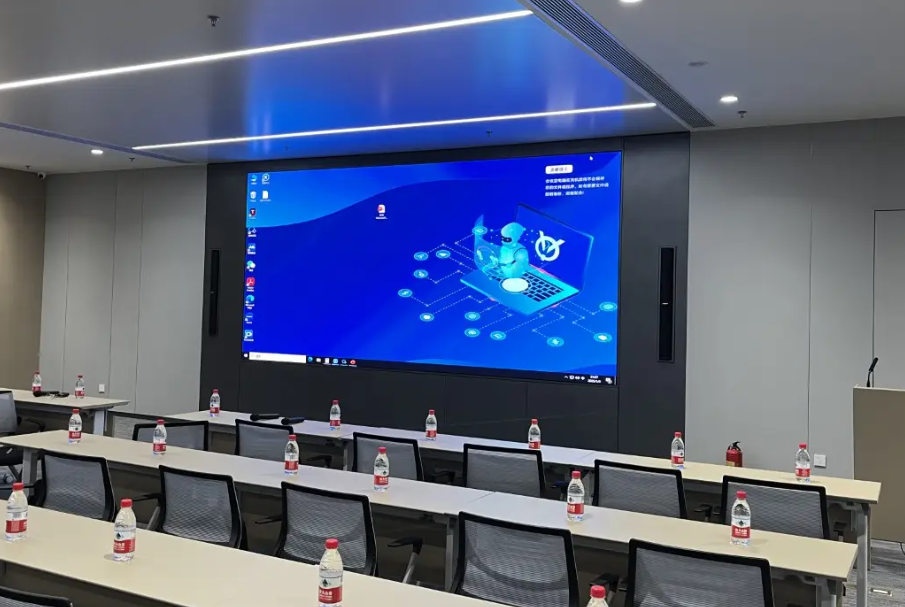
Indoor fine-pitch screens are viewed from close range and have high pixel density, demanding the utmost in seam flatness, image consistency, and operational stability. Hard connections eliminate human wiring errors, ensuring a seamless and flat display, while also offering an extremely low failure rate. They are well-suited for high-end, precision applications such as conference rooms, command centers, and live broadcast studios, making them the standard manufacturing process for fine-pitch LED displays.
Hard connections are preferred in harsh outdoor environments. Outdoor environments are dusty, humid, subject to extreme temperature fluctuations, and prone to vibrations. The external contacts of soft connections are susceptible to oxidation, moisture, and aging, leading to high failure rates. In contrast, hard connections feature a fully enclosed, integrated structure with superior dustproof, moisture-proof, and shock-resistant performance, ensuring more stable and durable long-term outdoor operation. For standard long-distance outdoor advertising screens, cost-effective soft connections can be selected.
The core requirements for rental screens are frequent assembly and disassembly, long-distance transportation, flexible setup, low damage rates, and low costs. Modules with soft connections are lightweight, slim, stackable, and capable of absorbing minor deformations; individual modules can be removed independently, and maintenance costs are extremely low—making them perfectly suited to the high-turnover nature of the rental industry. In contrast, hard-connected modules are rigid and fragile, suffer high transportation damage rates, and cannot be configured into irregular shapes, making them unsuitable for rental scenarios.
Yes.
Although the threshold for a single repair is higher with hard-connected screens, the overall failure rate is extremely low. There is no need for routine inspections to tighten cables, clean connectors, or address poor contact issues. Long-term labor and maintenance costs, after-sales repair costs, and equipment wear-and-tear costs are far lower than those of soft-connected screens, making them more cost-effective over the long term.
Absolutely not.
Rigid-connection modules feature a fixed, inflexible structure that cannot bend or deform; they support only standard flat-panel assembly. Creative LED screens requiring curved, circular, contoured, column-wrapped, or irregular shapes can only achieve these forms through the flexible, bendable nature of soft-connection modules.
Given identical LED specifications and operating environments, rigid-connection modules offer a longer service life. Soft-connection systems rely on components such as cables, terminals, and contact points that are prone to wear and tear; these degrade over time due to environmental factors, thereby shortening the screen’s overall lifespan. In contrast, rigid connections lack external vulnerable parts, offering circuit stability and superior resistance to aging, which maximizes the screen’s total service life.
Use these quick selection criteria: choose soft connections if the priority is unique shaping, ease of assembly/disassembly, or low cost; choose rigid connections if the priority is high resolution, surface flatness, stability, or low maintenance. Making the right choice involves considering the project scenario, budget, expected service life, and viewing distance.
The soft-connection and hard-connection technologies for LED displays are not mutually exclusive alternatives; rather, they represent two mature technical systems that complement each other across different application scenarios and market positionings. Each addresses specific market demands, engineering environments, and budget structures, offering unique and irreplaceable value within the industry.
When implementing LED projects, contractors and purchasers should avoid both the blind pursuit of high-end technology and the excessive cost-cutting associated with low-spec solutions. Instead, decisions should be based on a comprehensive assessment of factors such as design requirements, usage frequency, viewing distance, precision standards, budget, and expected lifespan. By precisely matching the connection technology to the project needs, stakeholders can fundamentally enhance display quality and operational stability, reduce lifecycle maintenance costs, and deliver professional LED display solutions that offer excellent suitability, cost-performance, and reliability. As LED display technology continues to evolve, both soft- and hard-connection technologies will undergo further optimization, providing the industry with increasingly professional, mature, and intelligent solutions for a wide range of display applications.
