
Recently, glass substrates have gradually entered the LED display industry’s field of vision, moving beyond semiconductor packaging. As Mini LED and Micro LED evolve towards smaller chips, higher density, and finer circuitry, traditional PCBs face new challenges in terms of dimensional stability, circuit precision, and large-area processing.
This makes glass substrates a noteworthy new technological route for the LED display industry.
However, glass substrates are not simply a replacement for PCBs. For LED displays, their true value lies in addressing the new requirements for flatness, circuit precision, and dimensional stability arising from high-density chip integration.
Why is LED Displays Starting to Focus on Glass Substrates?
Currently, most LED display products still use PCBs as the primary substrate. The PCB supply chain is mature, costs are relatively controllable, and a complete system has been established for module manufacturing, repair, and mass production.
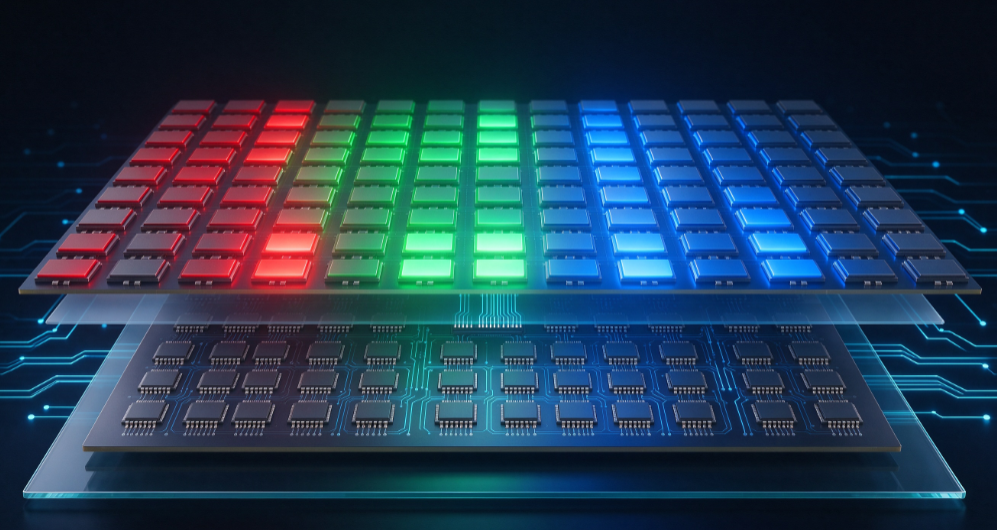
However, as Mini LED backlighting progresses to high-zone or even RGB Mini LED stages, or Micro LED displays evolve towards smaller pixel pitches, the number of chips and circuit density will increase significantly.
At this point, the flatness and thermal stability of the substrate become even more crucial.
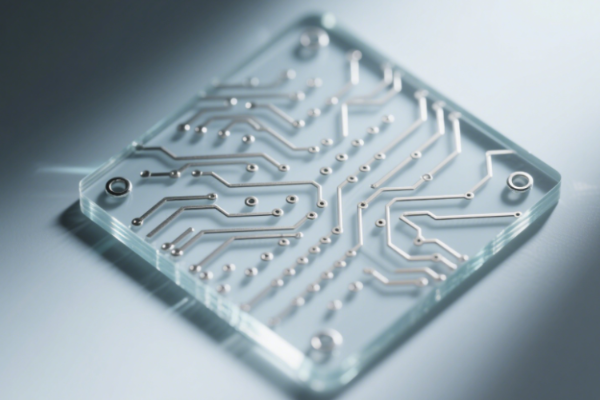
Glass has high surface flatness and good dimensional stability, providing a more stable foundation for high-density chip arrangement and fine circuit processing. In large-area display modules, this stability can also reduce the impact of substrate expansion and contraction on chip mounting, module splicing, and display consistency.
Therefore, glass substrates are more suitable as a potential technological solution for high-precision, high-density LED displays.
Which LED Display Technologies are Suitable for Glass Substrates?
Currently, two main areas are worth paying attention to:
- Mini‑LED Backlight Unit
As the number of backlight zones increases, so does the circuit density and chip count. This is especially true for RGB Mini LED display solutions, which place higher demands on the precision of the driving circuitry and chip arrangement.
Glass substrates, combined with fine circuit processing, provide a stable foundation for high-density Mini LED arrays.
- Direct‑view Micro‑LED
Micro LED requires even higher substrate precision. For TFT glass backplane solutions, the driving circuitry can be directly formed on the glass, followed by Micro LED chip transfer, bonding, testing, and repair.
This means that the glass in Micro LED does more than just “carry the chips”; it can potentially become part of the display backplane and driving system.
Can Glass Substrates Directly Replace PCBs?
In the short term, the answer is not a simple “yes.”
PCBs currently boast lower manufacturing costs, a mature supply chain, and a comprehensive repair system.
While glass offers advantages in flatness and precision machining, it also faces challenges such as large-size processing, brittleness,, equipment investment, and subsequent maintenance.
Furthermore, the advantages of glass substrates are only truly realized in specific applications.
What does Glass Substrate Mean for the LED Display Industry?
The real significance of glass substrates isn’t just a change of material, but rather their potential to drive the LED display industry towards smaller pitches, higher integration, and more refined manufacturing.
For products with high precision and optical performance requirements, such as Mini or Micro LED, transparent LED displays, automotive LED displays, and AR-HUDs, glass substrates have further development potential.
However, whether this technology can ultimately achieve large-scale adoption in the LED display market depends on yield rates, manufacturing costs, chip transfer efficiency, and overall screen reliability.
Therefore, rather than discussing “whether glass will replace PCBs,” it’s more relevant to focus on a more practical question: As LED displays enter a higher-density era, what kind of substrate can achieve a better balance between performance and cost?
This is perhaps the real question that glass substrates need to answer.