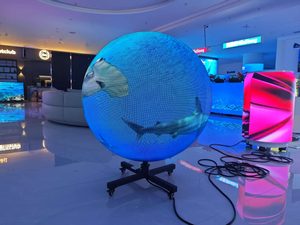

A question that comes up repeatedly in sphere LED display projects: why can some venues only use floor-mounted installation, while others can only use suspension?
For sphere LED displays, these are not simply two different construction methods. They correspond to different product structures, different load-bearing logic, and different site conditions. For medium and large projects especially, skipping a structural and installation assessment early on frequently leads to redesigns, on-site rework, and ongoing maintenance difficulties.
The Load-Bearing Logic Is Completely Different
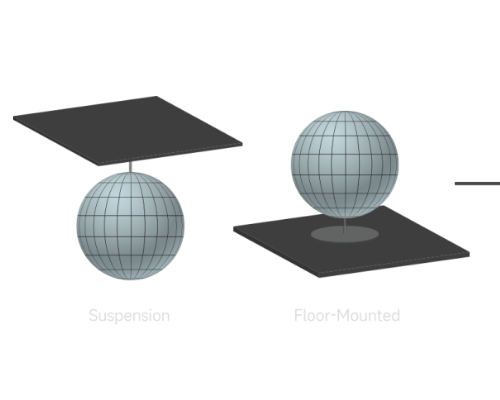
Floor-mounted installation is the more common approach for large sphere LED displays. The weight of the sphere is transferred through an internal radial steel structure down to a base, which is then supported by the building’s floor. This places minimal demand on the roof structure overhead.
In practice, floor-mounted solutions cover small spheres (Φ1m–Φ4m), medium spheres (Φ4m–Φ8m), and large sphere LED displays above Φ8m. For science museums, planetariums, and large cultural tourism immersive spaces designed for long-term operation, a floor-supported structure provides considerably more flexibility in terms of maximum size.
Suspended installation works completely differently. With no ground support, the full weight of the sphere must be transferred through a suspension disc, steel cables, and pre-installed ceiling anchors to the building’s primary roof beams. Both the building structure and the product’s self-weight become critical constraints.
In standard commercial atrium and exhibition hall projects, Φ1m–Φ5m is the typical size range for suspension. Φ5m–Φ7m moves into custom territory requiring specialist structural assessment and reinforcement. Beyond this size range, the structural and safety risks of suspension increase significantly.
Sphere Weight Directly Shapes the Suspension Solution
As sphere diameter increases, total weight grows substantially — and this is a primary reason why suspension has size limitations.
Based on project experience, lightweight sphere LED displays in the Φ1m–Φ4m range may weigh approximately 0.1–3.6 tonnes. Custom lightweight suspended products in the Φ4m–Φ6m range may reach approximately 3.8–6.5 tonnes.
For suspended installations, the industry standard is to apply a safety factor to the design load. If a sphere’s total weight is 4.2 tonnes, designing to a 5× safety factor means the suspension anchors and supporting structure must be rated to carry no less than 21 tonnes.
Floor-to-Ceiling Height Is an Easily Overlooked Constraint
Beyond weight and structural capacity, available height directly affects which installation method is viable.
For floor-mounted installations, a useful starting point is to allow for sphere diameter plus approximately 1.2m of overhead service clearance, while also accounting for the height of the base structure.
Suspended installations do not require floor space, but they do need to accommodate both the ceiling rigging hardware above and a safe clear zone below the sphere. When ceiling height falls below approximately 6.5m, the spatial fit for medium-size suspended spheres becomes significantly more constrained.
This is why the same sphere size may require a completely different installation approach depending on the building.
Sphere LED Display Projects Require Engineering-Grade Selection
Many suppliers in this market simply ship hardware — they lack sphere-specific structural expertise and end-to-end project delivery experience. Applying generic flat-screen solutions to sphere projects is a common source of problems: mismatched specifications, structural incompatibility, poor installation practice, balance issues, and insufficient load capacity.
MileStrong has developed a complete and proven sphere LED display project delivery system built specifically for custom non-standard sphere applications. Based on your site’s ceiling height, structural load capacity, and spatial layout, MileStrong provides a one-to-one matched installation recommendation — floor-mounted or suspended — and delivers the full project lifecycle: site survey, custom engineering, dedicated structural design, standardized installation, precision calibration, and ongoing maintenance support. Every stage is covered to eliminate project risk at the source.