
The 2026 World Cup is over. After July 19th, the match footage stopped, temporary facilities began to be removed, and venues returned to their regular operating schedules. SoFi Stadium in Los Angeles has already completed its post-World Cup venue restoration and switched back to NFL season operations.
But one thing did not end with the final whistle — the LED display systems inside the stadiums are still running. This is one of the more easily overlooked questions that large sporting events leave behind.
During the World Cup, a stadium’s LED display infrastructure had to handle scores, replays, advertising, event information, live audience interaction, and a significant volume of broadcast-related content. Some of that equipment was added specifically for the tournament. Some belongs to the venue’s permanent system. Their futures are not the same.
The question worth asking is which screens stay, and what they can do once they do.
A World Cup Does Not Just Add a Big Screen to a Stadium
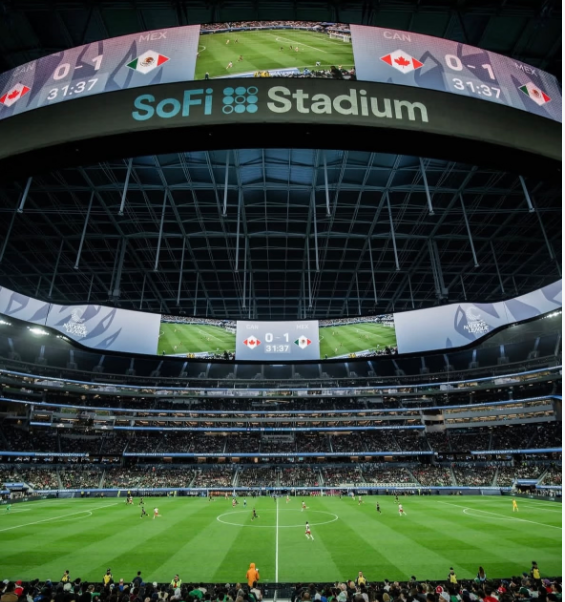
A large stadium typically operates multiple display systems simultaneously — main video screens, Ribbon LED, pitch-side LED Perimeter LED Displays, entrance information screens, commercial advertising screens, VIP area displays, and various digital signage. These systems are not connected to a standalone media player. They are integrated with the stadium’s control, network, and content infrastructure.
FIFA’s stadium technology guidelines explicitly state that large stadiums should be equipped with giant video screens for team lineups, match replays, advertising, and announcements — and that display systems should be integrated into the venue’s internal video and network distribution architecture. For large venues, the positioning, viewing distances and content legibility of display equipment are also factors to be addressed during the architectural and technical design phase.
How Does the System Switch From Event Mode Back to Everyday Operations?
Scenario One: The Equipment Stays and Continues Serving the Stadium
This is the most desirable outcome — and the one most easily taken for granted. The World Cup occupies a small fraction of a large stadium’s annual operating calendar. A major venue may host dozens of events per year across multiple sports and entertainment categories. That means the LED display equipment used during the World Cup, if the hardware specification and system architecture meet long-term operational requirements, does not need to be decommissioned just because the tournament has ended. The content on the screens will change. The screens themselves do not have to.
From this perspective, the real value of stadium LED display infrastructure is not serving a single tournament — it is carrying the venue’s content operations for years or even decades afterward. This is why stadium projects are increasingly unable to evaluate LED systems purely on peak brightness, pixel pitch, and price. Whether the system can continue to operate reliably over time often matters more than its performance during any single event.
Scenario Two: Temporary Equipment Is Removed
A different fate awaits another portion of the equipment. Large international events bring significant temporary infrastructure. FIFA’s own stadium design guidelines refer to this category as “overlay” — facilities added for a major event and removed once it concludes. One of the purposes of modular design is to allow certain assets to serve both temporary event needs and future redeployment.
LED display equipment follows a similar pattern. Additional pitch-side screens, temporary information displays, and event zone displays are not necessarily permanent venue assets. After the event, they may be dismantled, transported to other venues, or returned to the rental market. This is one of the fundamental distinctions between Rental LED and Fixed Installation LED.
Scenario Three: The Screens That Stay Need to Learn How to Generate Revenue
This may be the most practical challenge stadiums face once the World Cup ends.
During the tournament, a stadium enjoys global visibility. Advertising inventory, media exposure, and on-site audience figures are all in an exceptional state. After the event, conditions are fundamentally different. Without a World Cup providing the draw, stadiums must sustain revenue through their regular event calendar.
At that point, the role of the LED display system changes. It is no longer just showing match footage. It takes on a broader set of commercial responsibilities — concerts, automotive launch events, international competitions of other kinds.
What the World Cup ultimately leaves behind may not be any particular LED module. It may be a digital media infrastructure that can sustain continuous operations.
From Event Equipment to Venue Infrastructure
This may be the more significant shift worth observing in the stadium LED market after the 2026 World Cup.
FIFA’s approach to stadium information technology planning already emphasizes the connection between video screens, networks, control systems, and venue operations. Large video screens need to be integrated into central control systems with appropriate equipment space, power provision, and operational access to accommodate future temporary upgrades or large special events.
This points to a clear direction: stadium LED display is increasingly difficult to understand as simply a screen. It is closer to a piece of venue infrastructure.
- Today it serves a World Cup.
- Tomorrow it serves a league match.
- Next month it serves a concert.
For stadium operators, the calculation that actually matters is not how much LED display was used during the World Cup. It is how many times that LED display will be used after the World Cup is over.
If an LED display system can move smoothly from World Cup mode into league seasons, concerts, commercial events, and daily advertising operations — then what it has always been serving is not one tournament. It has been serving the business of that stadium for many years to come.