LED Displays vs Projectors: Which Is Better for Meeting Rooms?
In corporate meeting rooms, training centers, and large conference halls, display devices directly impact the meeting experience. In the past, projectors were the common display equipment in meeting rooms. Now, with the development of LED display technology, more and more companies are considering LED displays.
So, what are the differences between LED displays and projectors? Which display solution is better for a meeting room?
Actually, both solutions have their own advantages. The final choice needs to consider factors such as meeting room size, viewing distance, ambient light, usage frequency, and budget.This article will compare LED displays with projection in terms of display effect, ambient light, installation and maintenance, lifespan, viewing experience, and application scenarios to help companies choose the more suitable meeting room display solution.
The Fundamental Difference Between LED Displays and Projectors
LED displays use LED light-emitting diodes as their display units. Multiple LED modules can be combined to create displays of different sizes. They do not require a projection device or screen; the screen itself is the image display medium.
On the other hand, projectors emit light from a light source to project an image onto a wall or screen. The final projected image quality is affected by the projection distance, screen quality, and ambient light.
Simply, LED displays are self-illuminating. Projectors create images by projecting light. This is a key reason for the differences between the two display technologies in conference room applications.
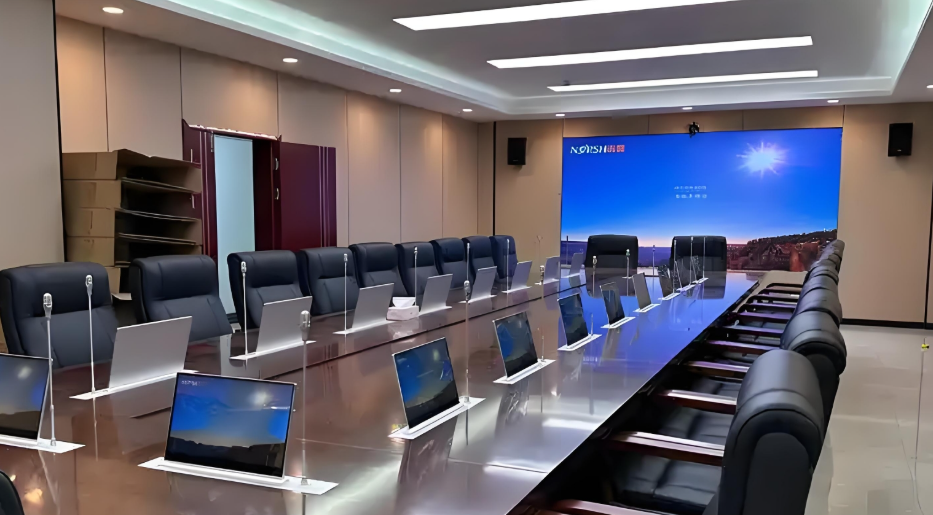
Key Comparisons Between LED Displays and Projectors
When choosing a conference room display solution, focus on comparing the following aspects.
Display Performance: LED Displays Offer Greater Stability
During meetings, it’s common to display PPT presentations, spreadsheets, videos, and product images. This type of content demands high clarity.
LED displays use direct pixel emission, providing stable brightness and a clear image. By selecting the appropriate LED pixel pitch, the screen can meet close-up viewing requirements. For example, in corporate conference rooms, small-pitch LED displays such as P1.2, P1.5, and P1.8 can be chosen. Smaller pixel pitch generally results in higher pixel density per unit area, leading to clearer image details at close range.
However, Projectors project images onto a screen or wall. In bright conference room environments, the display image can be easily affected. This is especially true when playing dark backgrounds or videos, where the projected image’s detail and clarity may decrease.
Therefore, if the conference room has high requirements for high-definition displays, image detail, and stable display, LED displays are generally more advantageous.
Ambient Light: LED Displays Are Better Suitable for Bright Conference Rooms
Conference rooms aren’t necessarily completely enclosed spaces. Many corporate conference rooms have large windows. During daytime meetings, outdoor light enters the room. In this situation, projectors often encounter a problem: ambient light reduces the visual quality of the projected image. To ensure a clear image, curtains need to be closed or indoor lights dimmed. While this improves the projection effect, it can negatively impact the meeting environment.
However, LED displays don’t rely entirely on dark environments. LED displays are self-illuminating, maintaining high screen brightness. Therefore, even with normal lighting in the conference room, text, charts, and video content can be clearly displayed. This is crucial for spaces such as corporate boardrooms, training rooms, and product launch rooms. Meetings don’t require changes to normal lighting for the display device.
This is one of the key reasons why conference room led displays are increasingly attracting attention from corporate clients.
Screen Size: LED Displays Offer Greater Flexibility
Different meeting rooms have different sizes. Small meeting rooms may only require display devices of a few tens of inches, while large conference halls may need screens exceeding 100 inches or even larger.
Projectors typically require consideration of projection distance and projection area. On the other hand, LED displays can be combined through modules and cabinets. Different screen sizes can be customized based on wall size and viewing requirements.
For example:
- Small meeting rooms can install small-sized LED displays;
- Medium-sized meeting rooms can use 16:9 aspect ratio LED screens;
- Large conference halls can use larger LED display walls;
- Training centers can design ultra-wide displays based on seating layouts.
This modular design gives LED displays a high degree of size flexibility.
Viewing Experience: LED Displays Offer a More Direct View
Conference display equipment needs to be not only clear but also comfortable to view.
Projectors project light over a distance. If people stand directly in front of the projection area, they may obstruct the view.
LED displays eliminate this issue of projection obstruction. Furthermore, LED displays provide stable brightness. Combined with a higher refresh rate, video and dynamic content playback is smoother.This is especially convenient for meeting rooms that frequently display promotional videos, product demonstrations, and company data.
Of course, the pixel pitch of the LED display needs to be selected based on the viewing distance. If the conference table is very close to the screen, it is recommended to consider small-pitch LED products. This reduces the graininess when viewing at close range.
Installation Space: LED Displays Save Projection Space
Installation space is an issue many businesses easily overlook. Projectors aren’t simply hung on the ceiling of a meeting room. They need to maintain a suitable distance from the projection screen. The installation location, projection angle, and wiring layout must also be considered. If meeting room space is limited, projection distance can become an issue.
LED displays can be mounted directly on the wall. There’s no need to reserve projection distance between the screen and the device. Therefore, meeting room space can be utilized more efficiently. This is a real advantage for meeting rooms with limited space.
Maintenance: LED Displays are More Modular
Meeting room display equipment typically requires long-term use.
Projectors mainly require maintenance of the light source, filters, cooling system, and the device itself. After prolonged use, some components may need to be replaced.
LED displays use a modular structure. When a particular LED module malfunctions, the faulty area can be inspected and replaced, rather than necessarily replacing the entire screen.
Professional LED displays often offer front or rear maintenance designs depending on the product structure. If the meeting room screen is mounted on a wall, a front maintenance design is more convenient. Maintenance personnel can operate directly from the front of the screen.
Therefore, LED displays can provide a more flexible maintenance method in corporate conference rooms that are in long-term operation.
Lifespan: Long-Term Costs Matter
When purchasing conference room display equipment, the purchase price alone is insufficient. Long-term operating costs must also be considered.
The long-term costs of projectors typically include equipment purchase, light source replacement, filter maintenance, and other accessory costs.
LED displays primarily involve the costs of the screen itself, control system, power supply, and maintenance. LED displays generally have a long lifespan, but the actual lifespan is affected by factors such as product quality, operating environment, brightness settings, heat dissipation, and usage time.
Therefore, when selecting LED conference room displays, companies should not only compare the unit price.A more reasonable approach is to calculate the Total Cost of Ownership, considering not only the initial purchase price but also the required investment over the next few years.
Limitations of LED Displays
While LED displays offer many advantages, not all meeting rooms need to choose them.
First, the initial purchase cost of LED displays is generally higher than that of conventional projectors. For small meeting rooms with limited budgets and infrequent use, projectors may still have a price advantage.
Second, LED displays require professional design and installation. Screen size, pixel pitch, brightness, control system, and installation structure all need to be selected based on the specific conditions of the meeting room. Inappropriate selections can negatively impact the final result.
Therefore, the most important thing is that it’s suitable.
When Is an LED Display The Best Choice for Conference Room?
LED displays are generally a better option for conference rooms with the following characteristics:
- Bright Conference Room Environment: If the conference room is frequently used during the day and has ample natural light, LED displays can provide a more stable display effect.
- Requires High-Definition Display: If meetings frequently display Excel spreadsheets, data analyses, product images, design drawings, and high-definition videos, small-pitch LED displays can provide a clearer picture.
- High-Frequency Daily Use: If the conference room is used daily, the display equipment needs to operate stably for extended periods. In this case, LED displays are a strong consideration.
- Larger Screen Size: For large conference halls, corporate training centers, and multi-functional conference rooms, LED displays can be designed to fit the available wall space.
- Requires a High-End Conference Environment: LED video walls not only serve a display function but can also become an integral part of the conference room space. A well-designed screen ratio and installation can enhance the overall visual experience of the conference space.
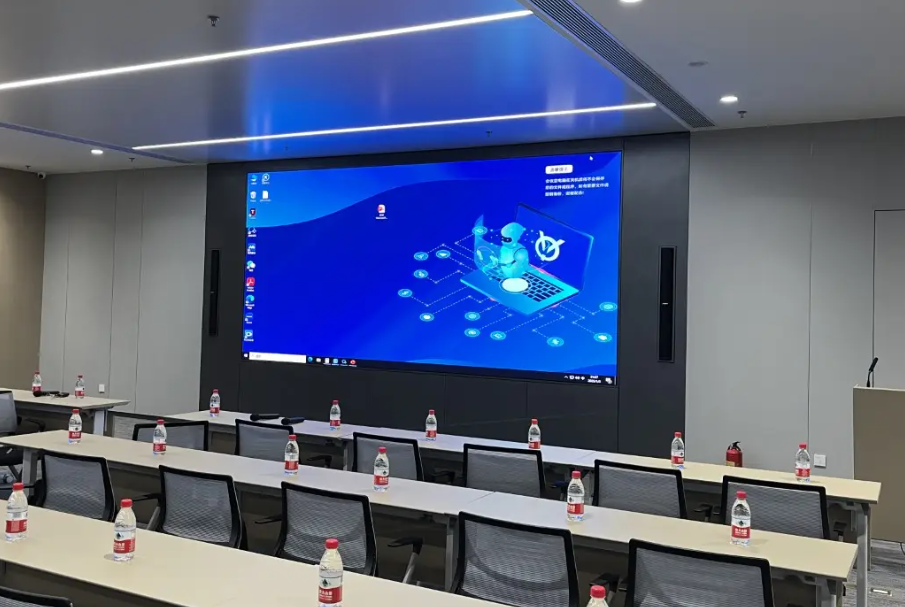
When Is a Projector Still a Worthwhile Choice?
Projectors haven’t been completely replaced by LED displays.
For small meeting rooms with limited budgets and primarily for simple PowerPoint presentations, projectors remain a practical solution. If the meeting room can control ambient light and doesn’t require very high screen brightness, a projection solution can meet basic needs.
Furthermore, for meeting spaces that require temporary setup, projection equipment typically offers greater flexibility.
Therefore, LED displays and projectors aren’t simply a matter of one replacing the other. The real choice should be based on project requirements.
FAQ: Common Questions about Conference Room LED Displays
- Are LED displays better than projectors for meeting rooms?
Not necessarily; the choice depends on actual needs. If the meeting room requires high brightness, high definition, and is used for extended periods daily, LED displays are generally more advantageous. If the budget is limited, the meeting room is small, and usage frequency is low, a projector can meet basic requirements.
- What pixel pitch should be chosen for an LED display in a meeting room?
It mainly depends on the viewing distance. For meeting rooms with close-range viewing, consider small-pitch LED displays such as P1.2, P1.5, and P1.8. If the meeting room is larger and the viewing distance is greater, consider products like P2 and P2.5. There’s no need to blindly choose the smallest pixel pitch.
- Which is more cost-effective, an LED display or a projector?
You can’t just compare the initial purchase price. Projectors generally have lower initial costs, while LED displays have a relatively higher initial investment. However, if the meeting room is used frequently and for extended periods, you also need to consider costs for equipment maintenance, light source replacement, lifespan, and ongoing maintenance.
- Can LED displays be used for video conferencing?
Yes. LED displays can be used to display various meeting content. For businesses that frequently conduct video conferencing, small-pitch LED displays, combined with appropriate brightness and a professional video conferencing system, offer superior display quality.
- Are LED displays suitable for small meeting rooms?
Yes, but the appropriate size and pixel pitch must be selected. Small meeting rooms typically have closer viewing distances, so small-pitch LED displays are recommended as a priority.
- Can LED displays replace projectors in meeting rooms?
In many meeting rooms, yes.Especially for projects with high requirements for image clarity, brightness, large display size, and long-term use, LED displays can already serve as a projector alternative. However, for small meeting rooms with lower budgets and lower usage frequency, projectors still have practical value.
Conclusion
choosing the right display equipment for a conference room depends on the specific usage requirements. LED displays and projectors offer different advantages.
Projectors still hold an advantage in low-cost, small conference rooms. LED displays are better suited for high-frequency use, high-definition display, large screen sizes, and modern meeting spaces.
If a company is planning a new conference room display system, it should first determine the conference room area, viewing distance, ambient light, and budget before selecting appropriate products. For corporate conference rooms intended for long-term use, choosing a suitable LED conference room display can not only improve image quality but also enhance the overall user experience of the meeting space.