COB vs GOB Package Technology: Differences, Advantages, and Applications
In the field of small-pitch, indoor high-definition LED displays, COB and GOB are the two mainstream protection and packaging technologies. Both are upgrades to address the pain points of weak protection and easy damage of traditional SMD LED displays, but there are still significant differences. This article compares the two technologies from all aspects, including principles, advantages,key differences and applicable scenarios, to help you clearly distinguish between them.
What Is The GOB Package Technology?
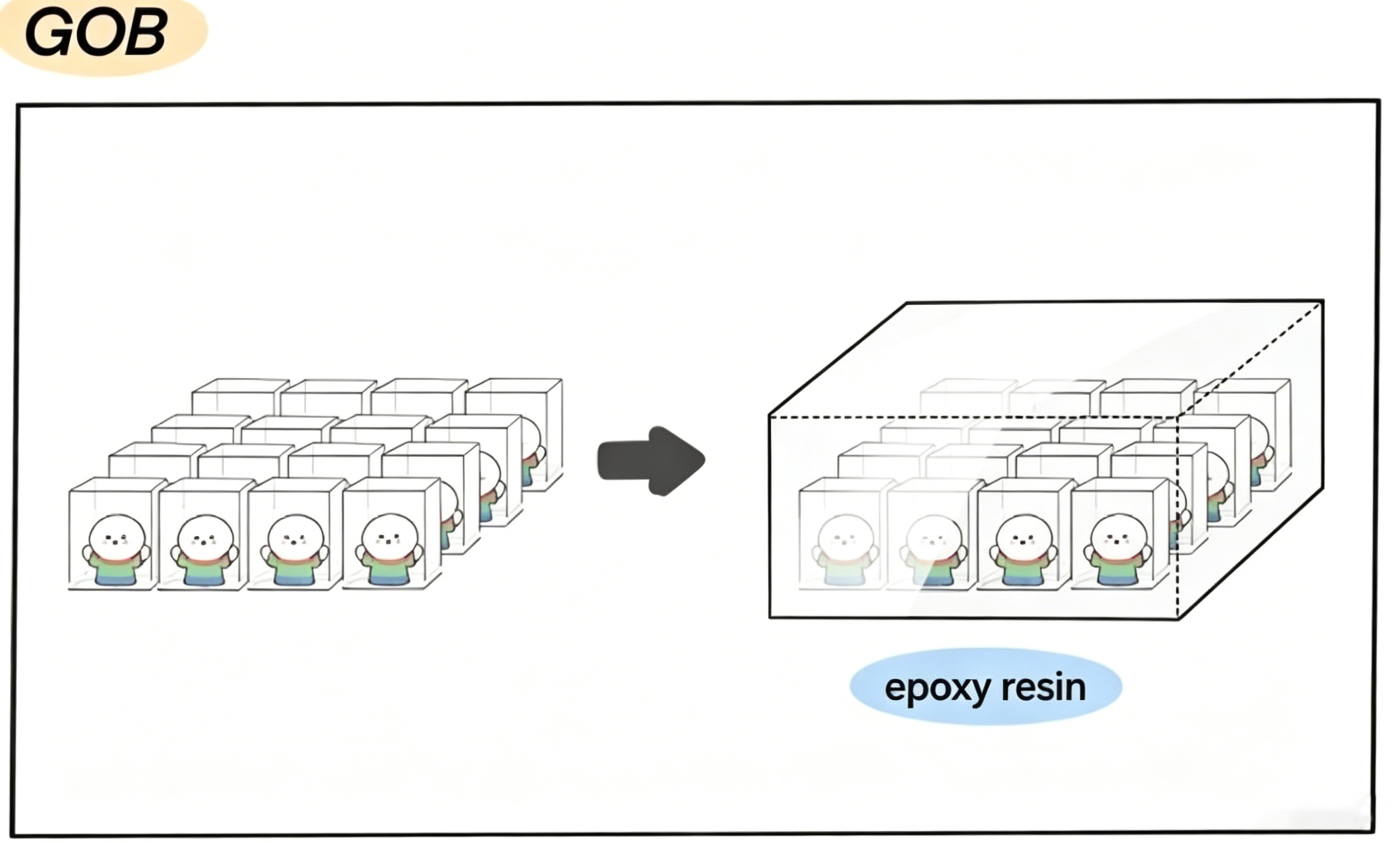
GOB (Glue On Board), which is essentially a protective upgrade solution for traditional SMD LED chips. Conventional surface-mount SMD LEDs are soldered onto the PCB circuit board, and then a layer of transparent epoxy resin is applied to the entire screen surface to completely cover all LEDs and solder joints.
Features:
- The LED chip remains an independent unit;
- An additional protective adhesive layer is added to the outside, which is considered an “external protection modification”.
What Is The COB Package Technology?
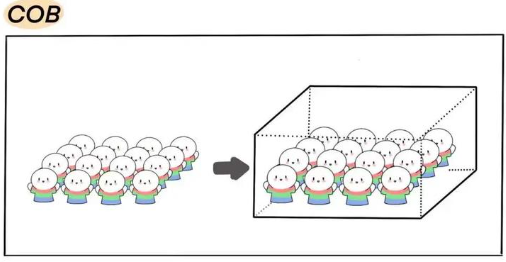
COB stands for Chip On Board, a brand-new chip-level packaging technology. It eliminates the need for separate SMD LED chips, directly bonding the bare LED chip to the PCB board, and then encapsulating and curing the entire assembly with adhesive.
Features:
- No separate LED structure;
- The chip and circuit board are integrated.
COB vs GOB: Key Differences
Protection Capability
GOB: The colloidal surface protects against dust, moisture, and minor impacts.
COB: Completely sealed with no exposed components, high protection level, adaptable to complex environments.
Display Performance
GOB: Slight graininess when viewed up close; a small amount of light refraction due to the surface adhesive layer
COB: Smooth, uniform screen surface with no graininess, high contrast, wide viewing angles, and a refined viewing experience up close.
Heat Dissipation
GOB: Heat is conducted through the LED pins and PCB board. The protective adhesive layer on the surface blocks heat dissipation, resulting in mediocre heat dissipation.
COB: The bare chip is directly bonded to the PCB, creating a short thermal path that allows for faster heat transfer and superior thermal performance.
Lifespan
GOB: Lifespan approximately 8-100,000 hours. Due to heat dissipation limitations, prolonged use at high brightness will accelerate LED aging.
COB: Lifespan approximately 10-160,000 hours. Lower operating temperature, slower chip aging.
Maintenance
GOB: If a single LED chip is damaged, the surface adhesive must be removed before replacing the chip.
COB: With its integrated packaging structure, a single point of failure cannot be repaired individually and usually requires replacement of the entire module.
Pixel Adaptation
GOB: Compatible with standard fine-pitch displays of P1.0 and above; due to LED chip size limitations, ultra-fine pitch is difficult to achieve.
COB: With no limitations imposed by individual LED chips, ultra-fine pitch ranging from P0.5 to P0.9 can be easily achieved.
Cost
GOB: Leveraging a mature SMD supply chain, GOB features a simple manufacturing process and low barriers to mass production, resulting in an affordable price point. At the same pixel pitch, it is significantly cheaper than COB.
COB: It involves complex chip bonding and packaging processes, requiring high-end production equipment and strict yield standards. Higher raw material and labor costs lead to a higher retail price for the finished product.
Advantages of GOB Package Technology
- Outstanding cost-effectiveness, ideal for projects with limited budgets.
- Adequate basic protection, suitable for general scenaries use.
- High compatibility, offering flexible project selection.
- Easy maintenance: If a single LED fails, the resin can be removed and the LED replaced without needing to replace the entire module.
- Stable optical performance and mature manufacturing processes ensure controllable light refraction and color accuracy.
Advantages of COB Package Technology
- Top-tier protection, capable of withstanding complex environments with high foot traffic and frequent collisions.
- Excellent display quality with high contrast and wide viewing angles, delivering a crisp viewing experience at close range.
- High thermal efficiency and long service life.
- Stable construction and low failure rate, ideal for 24/7 operation.
- Supports ultra-fine pixel pitch, free from the limitations of traditional LED sizes, to meet professional high-end display requirements.
Which Package Technology Should You Choose?
GOB package technology is designed for cost-effective solutions in standard environments where there are no strict requirements for ultimate image quality or superior protection:
- Corporate conference rooms, standard exhibition halls, advertising screens in retail stores
- Small and medium-sized live streaming studiosand classroom displays
- Display projects with limited budgets and simple daily maintenance
COB package technology is designed for high-definition image quality, robust protection, and long-term stable operation, targeting high-end professional applications:
- Command and control centers, large-screen security monitoring displays, and high-end government exhibition halls
- Broadcast studios, professional film studios, and high-end conference rooms
- Public areas with high foot traffic and a high risk of impact
- Ultra-narrow-pitch projects intended for close-up viewing
Frequently Asked Questions
Q1: Why is COB more expensive?
A1: The chip bonding and integrated packaging processes for COB are complex. They require high-quality production equipment, materials, and strict quality control, which naturally results in higher costs.
Q2: Which one is better for high-temperature environments?
A2: GOB has limited heat dissipation; high temperatures accelerate light decay and increase the likelihood of failure. COB has better thermal conductivity and stronger heat resistance, making it more stable during prolonged operation in high-temperature conditions.
Q3: Will the adhesive layer on GOB yellow or peel over time?
A3: MileStrong ’s products use high-quality transparent adhesive, which is unlikely to yellow or peel during 5–8 years of normal indoor use; COB models feature integrated encapsulation, offering superior adhesive stability and virtually eliminating such issues.
Q4: Which model is more comfortable for the eyes and less likely to cause eye strain during prolonged viewing?
A4: COB uses a diffuse light source, providing soft, even illumination without visible light spots, making it gentler on the eyes during extended viewing; GOB emits point-source light, with visible light spots at close range, which can lead to visual fatigue more easily.
Q5: Can curved or custom-shaped screens be made?
A5: Both types can be made into curved or custom-shaped screens. GOB offers more customization options for non-standard shapes at a lower cost; COB, due to the limitations of its integrated packaging, faces greater manufacturing challenges for non-standard shapes, resulting in higher customization costs.
Q6: How should I clean the screen regularly? Can I use alcohol or cleaning agents?
A6: For both types, we recommend wiping with a slightly damp soft cloth and water. We do not recommend frequent use of high-concentration alcohol or strong chemical cleaners, as these can corrode the surface resin and accelerate aging.
Conclusion
From technological characteristics to practical applications, COB and GOB offer distinct product positioning. COB excels in scenarios such as command centers, conference rooms, and exhibition halls where close-range viewing and high image quality are required; GOB effectively withstands rain, dust, and physical impacts, offering excellent value for cost and easy maintenance.
Neither is inherently superior to the other; only by carefully matching the solution to the specific conditions of a project can optimal performance and cost-effectiveness be achieved.