LED Dome Theater: A Complete Guide to Types, Sizes, Technology, and Design
LED dome theater systems are becoming a popular choice for immersive displays, combining LED technology, dome structures, spatial audio, content systems, and real-time rendering into a complete immersive environment.
LED dome theater s are becoming a popular choice for immersive displays . They are used in science centers, planetariums, theme parks, cultural tourism projects, flight simulators, and driving simulators. LED technology is turning traditional dome projection into a new type of immersive space built directly with LED displays.
Unlike regular LED screens, an LED dome theater involves much more than just curving the screen. A complete LED dome project includes: dome structure, LED display, pixel pitch selection, image mapping, video processing, audio, content creation, building space, cooling, power, and maintenance.
So for anyone planning to build an LED dome theater , the key questions are not just “How much does it cost?” but:
This guide answers these questions from a practical standpoint. It covers types, sizes, core technology, site design, content production, costs, installation, maintenance, and project cases. It is written for project owners, engineers, system integrators, and procurement teams.
What is an LED Dome Theater?
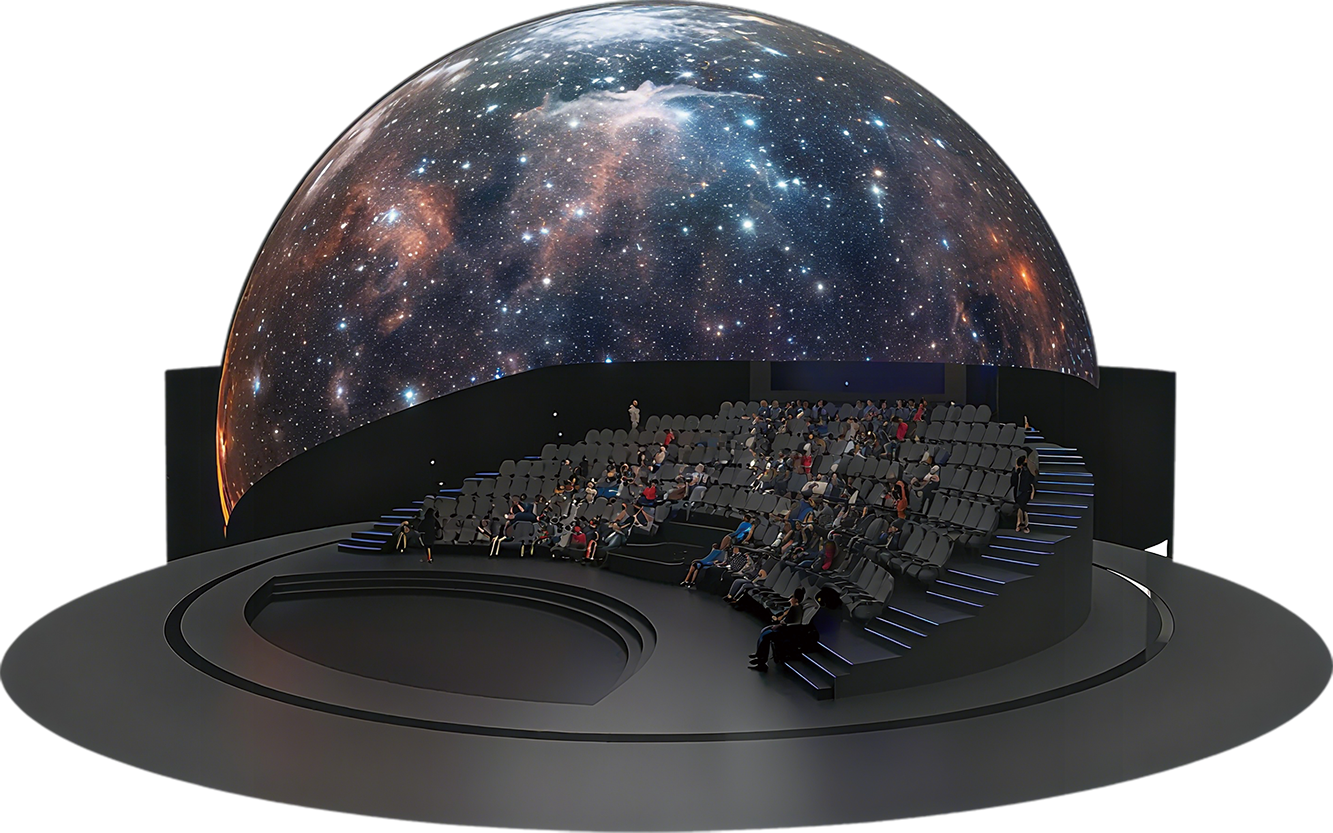
An LED Dome Theater is a display system that arranges LED panels into a spherical, dome, or curved shape. Combined with surround audio and custom content, it gives viewers an immersive visual experience.
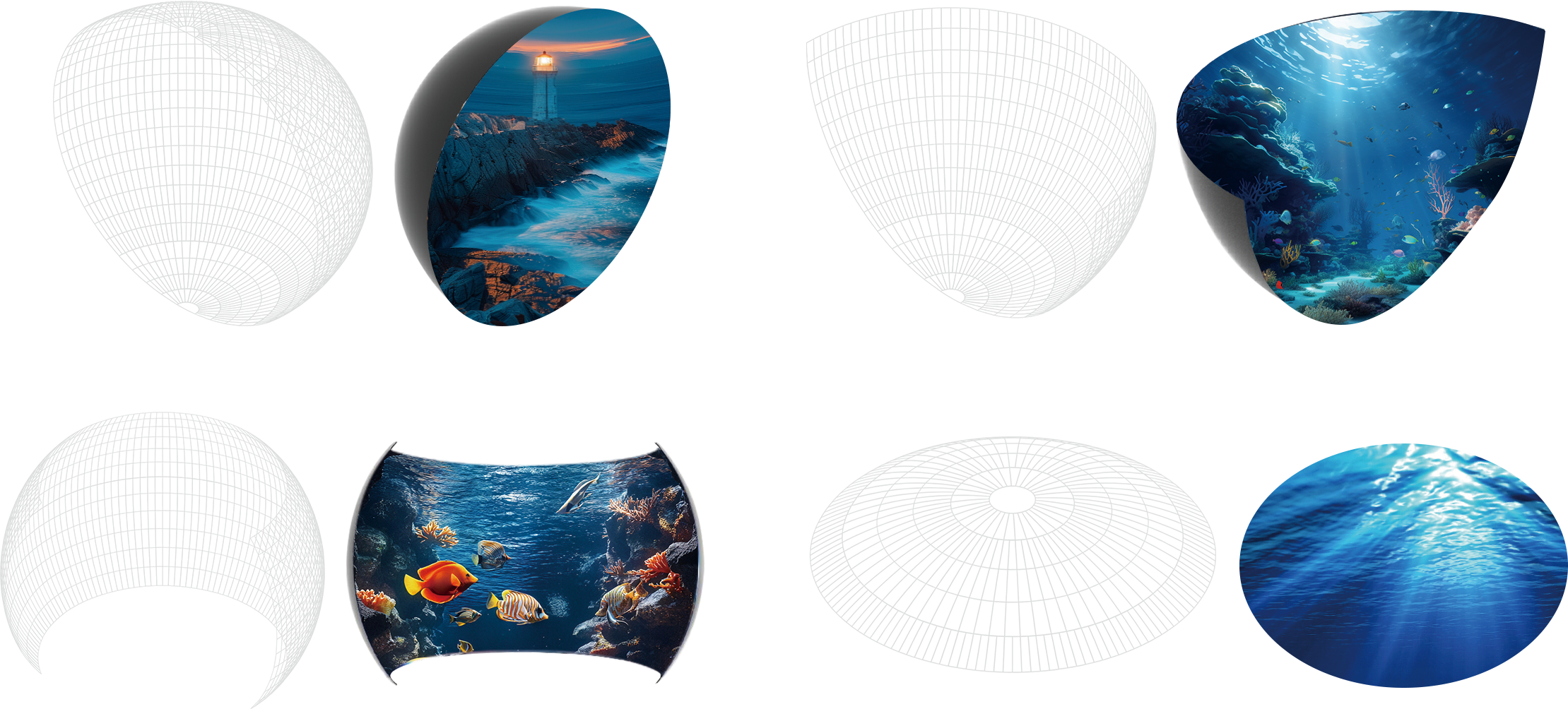
Depending on the project, the dome can be:
- Hemisphere
- Standard dome
- 180° immersive
- 360° panoramic
- Tilted dome
- Custom curved shape
Some commercial LED dome systems offer reference designs in diameters like 7m, 15m, 20m, and 25m. Each size comes with matching pixel pitch and resolution recommendations.
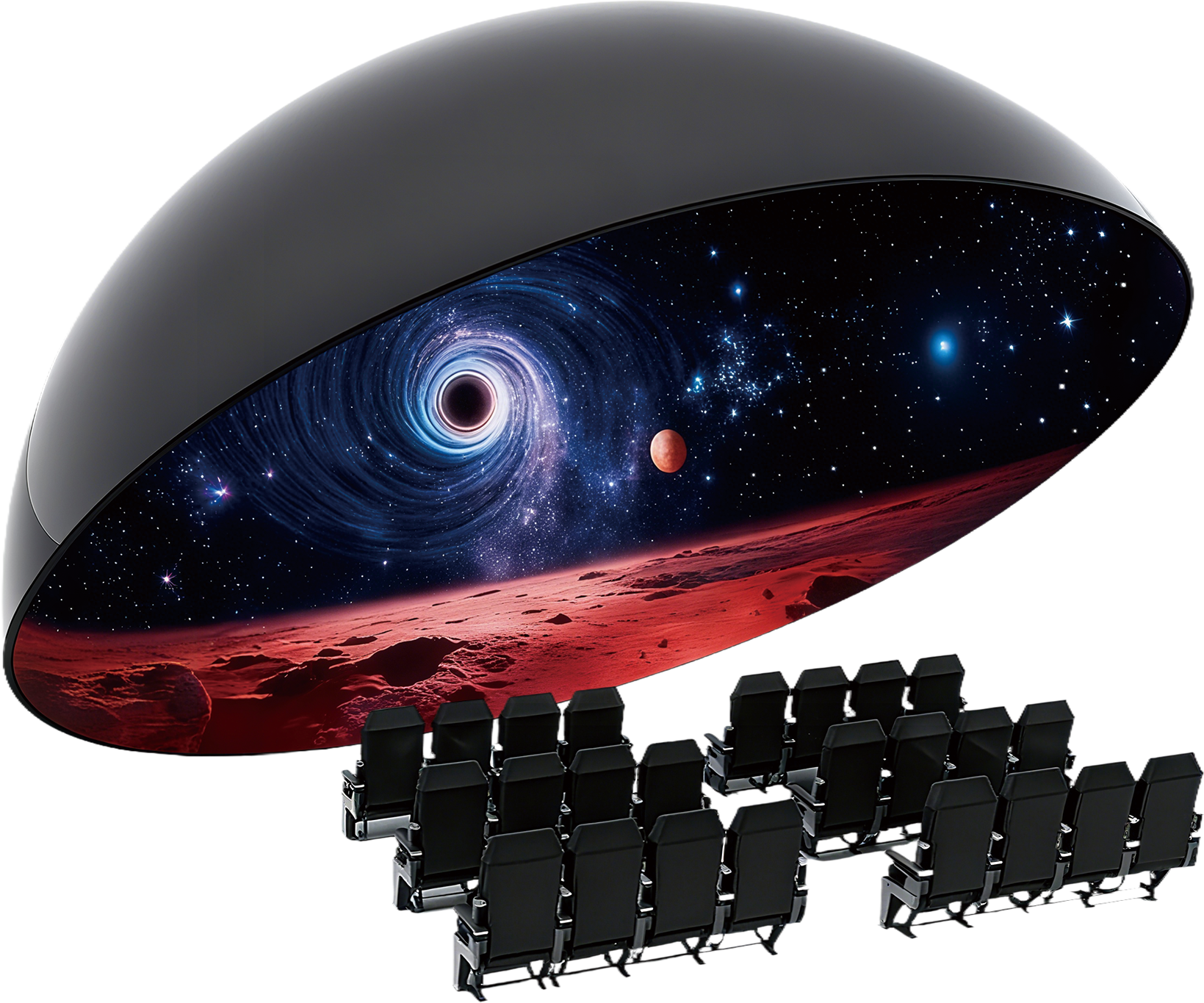
Challenges in LED Dome Design
The main challenge is showing a continuous, accurate image on a 3D curved surface. Beyond the LED panels themselves, the system must handle:
That is why LED dome projects require much more complex system design than standard LED video walls.
Types of LED Dome Theaters
LED domes can be customized for different uses. Here are four common types.
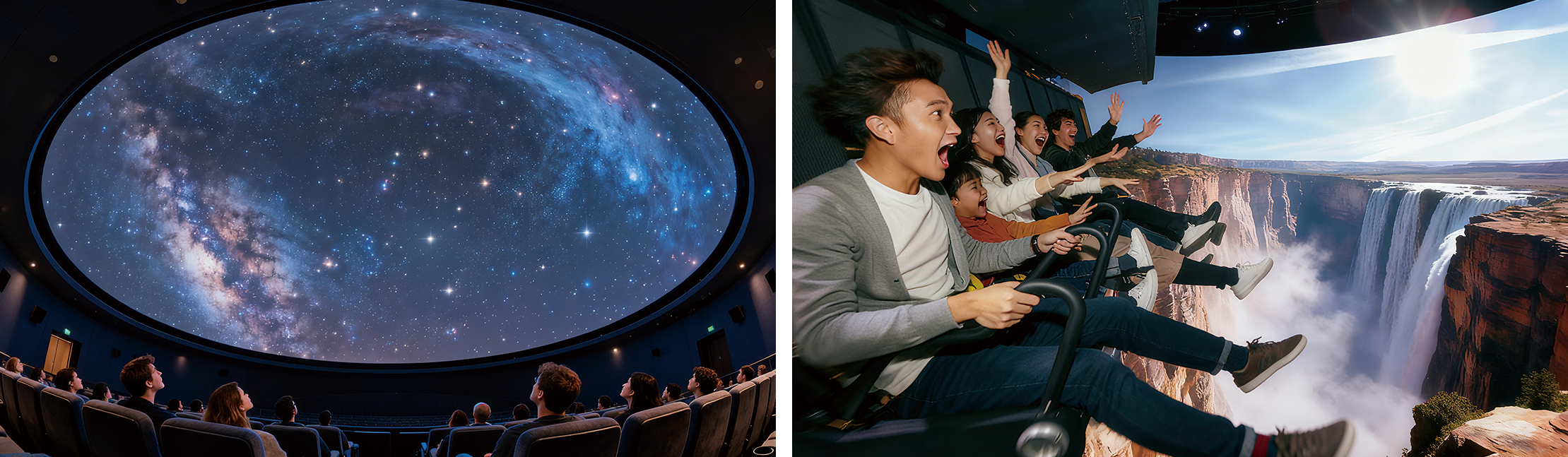
Educational & Science Domes
This is a very typical application.
Main venues:
- Science centers
- Planetariums
- Museums
- Science Popularization centers
- Study bases
- Educational exhibition halls
These domes show content that is hard to present on flat screens, such as:
- The universe and the Milky Way
- Solar system motion
- Earth evolution
- Deep-sea environments
- Geological changes
- Climate change
- Biology and ecosystems
Cultural Tourism & Entertainment Domes
Tourism projects focus more on:
- Visual impact
- Storytelling
- Immersive experience
- Commercial operation
Typical applications:
- Theme parks
- Tourist attractions
- Immersive experience halls
- Visitor centers
- Cultural exhibition spaces
- Large entertainment complexes
Content can be built around local culture, history, natural scenery, or sci-fi themes. For example, a scenic area can use the dome to show mountains, rivers, cities, history, and the future – all in one continuous fly-through. If you add motion seats, wind, fog, water effects, and surround sound, it becomes a multi-sensory experience.
Commercial & Brand Experience Domes
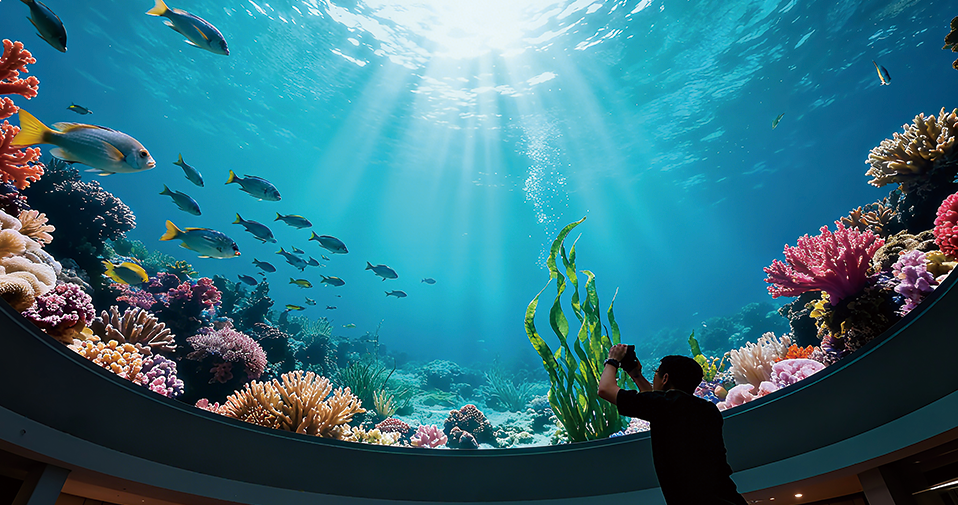
Commercial dome projects are often designed around visual impact, product storytelling, and high visitor engagement.
Typical applications include:
- Brand experience centers
- Corporate exhibition halls
- Technology showcases
- Product launches
- Commercial immersive spaces
Flight & Driving Simulation Domes
Simulation projects place higher demands on real-time rendering, low-latency control, multi-channel synchronization, and visual accuracy.
Typical applications include:
- Flight simulation
- Driving simulation
- Vehicle testing
- Training systems
- Research and development
LED Dome vs. Projection Dome – A Quick Comparison
| Item | LED Dome | Projection Dome |
|---|---|---|
| Display method | Self-emitting LEDs | Projectors投射 onto a screen |
| Brightness | Usually higher, less affected by ambient light | More sensitive to ambient light |
| Contrast | Direct pixel emission | Affected by projector and screen |
| Image formation | LED pixels form the display surface | Multiple projectors cover the dome |
| Curved surface handling | Curved LED structure + mapping | Geometric correction + edge blending |
| Maintenance | Modular panel replacement | Projector lamp / light source maintenance |
| Resolution scaling | Increase pixel count | Depends on number and quality of projectors |
| Audio | Can use acoustic-transparent LED | Can use perforated projection screen |
| Initial investment | Generally higher | Varies widely |
| Best for | High-end immersive, tourism, simulation | Planetariums, science, traditional dome shows |
What Size LED Dome Do You Need?
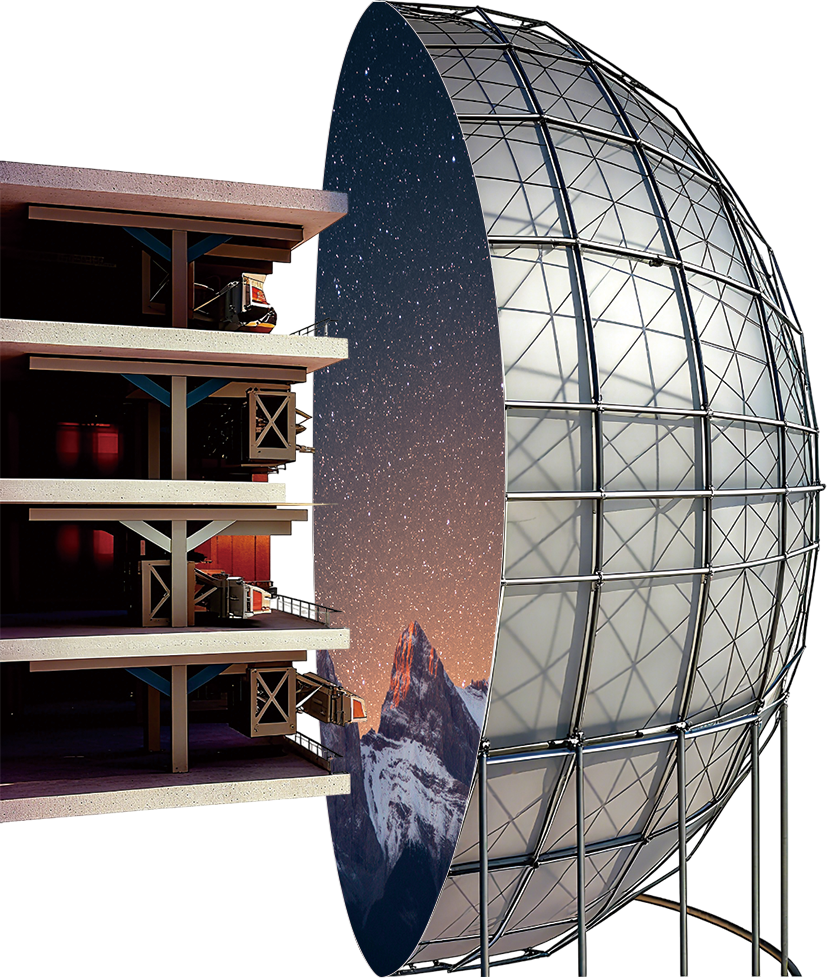
Dome size determines not only how immersive the experience feels, but also building requirements, LED cost, processing requirements, audience capacity, and maintenance.
| Size | Typical Diameter | Key Advantages | Typical Applications | Reference Resolution / Pixel Pitch | Considerations |
|---|---|---|---|---|---|
| Small | 1.5–8 m |
• Small footprint, low building requirements • Flexible deployment for small experiences |
• Commercial displays • Small experience halls • Auto experiences • Simulators • Small science projects |
~1.8–2.5mm pixel pitch for 7m systems | Limited audience capacity; no need for a huge dome just for immersion |
| Medium | 8–15 m | Good balance between screen area, audience size, immersion, and cost |
• Science centers • Museums • Study bases • Mid-sized cultural tourism • Immersive experience halls |
~2.5mm+ pixel pitch for 15m systems | The most common choice; balances multiple factors |
| Large | 15–25 m | Higher audience capacity and wider visual coverage |
• Large science centers • Theme parks • Cultural tourism complexes • Flying theaters • Large immersive entertainment |
20m/25m systems can reach 10K+ resolution |
• Heavier steel structure • Taller building space • Higher LED and power costs • More complex video processing • More demanding maintenance |
| Extra-Large | 25 m+ | Landmark appeal and ultimate immersion |
• Major cultural tourism attractions • City-level science museums • Super theme parks |
Not just a display – a full building-structure project | Requires early collaboration among: architecture, structural engineering, LED, audio-video, content, fire safety, HVAC |
Does an LED Dome Need 4K, 8K, or 16K?
There is no simple answer like “higher is better.” Current LED full dome projects use resolutions like 4K, 6K, 8K, 9K, 10K+, and even 16K. Commercial systems often offer 8K+ for 15m domes and 10K+ for 20–25m domes.
The real deciding factors are:
Dome size × Pixel pitch × Viewing distance × Content type × Playback system
Resolution Guide
| Resolution | Suitable Size / Scenario | Core Advantage | Typical Content | Trade-offs |
|---|---|---|---|---|
| 4K |
• Small domes • Basic science shows • Commercial displays • Legacy content systems |
Lower cost, less demanding on playback hardware, good enough for basic immersion |
• Basic educational films • Commercial demos • Simple visuals |
May not fully use the LED’s pixel capability on larger domes; limited detail |
| 8K |
• Medium-large domes (e.g., 15m+) • High-end immersive halls • Flight simulators |
Much higher spatial detail; sharper image; now a key target for premium LED full dome production |
• Starry skies / astronomy • City flyovers • Natural landscapes • Sci-fi / flight simulation |
Industry workflows already exist for 8K content; good balance of quality and cost |
| 10K+ |
• Large domes (20m, 25m) • Theme park centerpieces • Major science museums |
Delivers required pixel density for very large screens; keeps close-up views sharp |
• Large-scale immersive films • High-detail digital art • Ultra-wide-angle content |
Common in commercial 20–25m systems |
| 16K |
• Extra-large domes (25m+) • Top-tier landmark projects |
Ultimate pixel density, unmatched detail and immersion |
• Premium sci-fi productions • High-precision scientific visualization • Custom art content |
Not a must – it significantly increases LED cost, content production cost, storage, server load, and data transfer. Only for very large projects with big budgets. |
Core Display Technologies for LED Domes
1. Curved LED Modules & Spherical Structure
To create a continuous curved surface, you must handle:
- Curvature
- Cabinet angles
- Module arrangement
- Splicing accuracy
- Structural stability
2. Spherical Mapping & Geometric Correction
Normal video is designed for flat 2D screens, but a dome is 3D. Therefore you need:
- Dome mapping
- Warping
- Geometry correction
These processes map the content correctly onto the spherical surface. As defined by IMERSA, a Dome Master is a representation of a 3D hemispherical display space converted into a 2D image using special fish-eye or azimuthal equidistant projections. That is why a standard 16:9 video cannot be used directly as a complete full dome show.
What is an Acoustic-Transparent LED Dome?
Matching Sound With the Visual Source
If you want a truly immersive cinema, you cannot separate LED display and sound. Imagine an aircraft flying over the audience – if the sound always comes from the bottom or sides, viewers will clearly feel the mismatch.
Acoustic-transparent LED allows sound to pass through the display while maintaining image quality. This lets you place speakers closer to the actual sound source on screen, greatly improving audio-visual alignment.
Site Requirements for an LED Dome Theater
| Category | Item | Key Requirements | Risks if Ignored |
|---|---|---|---|
| Building Space | Floor area | Don’t just look at the dome diameter – allow for display area, equipment rooms, maintenance aisles, and evacuation paths | Equipment may not fit, or the audience experience feels cramped |
| Building Space | Ceiling height / floor-to-floor | Must accommodate dome steel structure + top equipment (e.g., hoist points, service platforms) + any raised floor below | Dome cannot be fully installed, or no overhead maintenance access |
| Building Space | Floor loading | Must support total weight of steel structure, LED panels, audio, cables, seats, audience, and motion equipment (if any) | For renovation projects, structural safety may be compromised |
| Structure & Installation | Steel structure | The dome support must be coordinated with the building’s main structure – either suspended or floor-supported | Misalignment can cause installation issues or long-term deformation |
| Structure & Installation | Maintenance access | Decide early: front-service or rear-service? How to remove modules, replace power supplies, repair receiver cards? Do you need service platforms or lifts? | Without planning, routine repairs become impossible – may require destructive disassembly, increasing operational costs |
| MEP (Mechanical, Electrical, Plumbing) | Power capacity | Total peak power of LED, servers, audio, motion equipment, HVAC – must include margin | Insufficient power can cause tripping or prevent full-load operation |
| MEP (Mechanical, Electrical, Plumbing) | HVAC | Cooling and ventilation must be calculated based on LED heat output, equipment heat, and audience comfort | High heat from LEDs and electronics must be planned from the start – retrofitting is very difficult and may cause overheating or damage |
| MEP (Mechanical, Electrical, Plumbing) | Heat dissipation | Must be designed together with power and HVAC – not added after installation | Heat buildup shortens equipment life and degrades display performance |
| Safety & Compliance | Fire safety | Must meet local fire codes: flame-retardant materials, smoke detectors, automatic suppression, emergency lighting | Failure to pass inspection or serious safety hazards |
| Safety & Compliance | Evacuation | Provide compliant emergency exits, aisle widths, and distances – consider rapid audience evacuation in emergencies | Non-compliance is illegal and life-threatening |
| Other Support | Equipment room | A dedicated room for media servers, audio-video processors, control PCs, network gear | Equipment scattered in the hall looks messy, and heat/noise can spoil the experience |
| Other Support | Audio system space | Reserve space for surround speakers and acoustic treatment to ensure even sound coverage | Sound and picture feel disconnected, ruining immersion |
FAQs
It is a cinema system that uses LED displays to cover a dome or spherical space, giving viewers an immersive visual experience.
Cost depends on dome size, pixel pitch, steel structure, control system, audio, content, motion equipment, and building modifications – there is no single price.
LED offers advantages in brightness, self-emitting display, and modular maintenance. But projection domes are still valuable in some planetariums, science centers, and budget-sensitive projects.
Not necessarily. 8K is great for many mid-to-large high-end LED fulldome projects, but the real need depends on dome size, pixel pitch, viewing distance, and content production capabilities.
Yes. LED domes work very well for flight simulation, but you will also need real-time rendering, low-latency control, multi-channel sync, and a motion platform.
Not for every project. If you want high-immersion audio with precise sound-to-image positioning, then acoustic-transparent LED combined with spatial audio is worth considering.
Conclusion
LED Dome Theater technology is changing the traditional dome cinema landscape. From projection-based domes to today’s high-pixel-density LED, self-emitting displays, spherical mapping, spatial audio, and real-time rendering, the dome has evolved from a simple “display” into a complete immersive digital space.
MileStrong provides full-chain services including LED display systems, structural design, control systems, installation guidance, on-site commissioning, and dome display optimization.